My Thanksgiving is perpetual. It is surprising how contented one can be with nothing definite — only a sense of existence. Henry David Thoreau
“Where the Divine and the Human Meet” shows how important it is to meet the world with the creativity of an artist, particularly in these uncertain times:
“What do we do with chaos?
Creativity has an answer. We are told by those who have studied the processes of nature that creativity happens at the border between chaos and order. Chaos is a prelude to creativity. We need to learn, as every artist needs to learn, to live with chaos and indeed to dance with it as we listen to it and attempt some ordering. Artists wrestle with chaos, take it apart, deconstruct and reconstruct from it. Accept the challenge to convert chaos into some kind of order, respecting the timing of it all, not pushing beyond what is possible—combining holy patience with holy impatience–that is the role of the artist. It is each of our roles as we launch the twenty-first century because we are all called to be artists in our own way. We were all artists as children. We need to study the chaos around us in order to turn it into something beautiful. Something sustainable. Something that remains”.” ― Matthew Fox, Creativity
Gratitude unlocks the fullness of life. It turns what we have into enough, and more. It turns denial into acceptance, chaos to order, confusion to clarity. It can turn a meal into a feast, a house into a home, a stranger into a friend. Gratitude makes sense of our past, brings peace for today and creates a vision for tomorrow. Melody Beattie
The Pilgrims made seven times more graves than huts. No Americans have been more impoverished than these who, nevertheless, set aside a day of thanksgiving. H. U. Westermayer
Thanksgiving comes to us out of the prehistoric dimness, universal to all ages and all faiths. At whatever straws we must grasp, there is always a time for gratitude and new beginnings. J. Robert Moskin
Appreciation can change a day, even change a life. Your willingness to put it into words is all that is necessary. Margaret Cousins
Let us remember that, as much has been given us, much will be expected from us, and that true homage comes from the heart as well as from the lips and shows itself in deeds. Theodore Roosevelt
If the only prayer you ever say in your entire life is thank you, it will be enough. Meister Eckhart
As we express our gratitude, we must never forget that the highest appreciation is not to utter words but to live by them. John F. Kennedy
Pride slays thanksgiving, but a humble mind is the soil out of which thanks naturally grow. A proud man is seldom a grateful man, for he never thinks he gets as much as he deserves . Henry Ward Beecher
Matthew Fox quotes a Biblical theologian who wrote that “there are two basic ways by which the God of the Bible deals with humankind: by deliverance and by blessing… Blessing – much less original blessing—has not been preached or taught in Christian spirituality for centuries” (Original Blessing, M. Fox).
We enter a broken and torn and sinful world—that is for sure. But we do not enter as blotches on existence, as sinful creatures, we burst into the world as ‘original blessings.’ (Original Blessing, M. Fox)
“At times, our own light goes out and is rekindled by a spark from another person. Each of us has cause to think with deep gratitude of those who have lighted the flame within us.” Albert Schweitzer
“In ordinary life, we hardly realize that we receive a great deal more than we give and that it is only with gratitude that life becomes rich.” Dietrich Bonhoeffer
“The coming of the kingdom of God is not something that can be observed,..because the kingdom of God is in your midst.” Lk 17:20-21
But if I cast out demons by the finger of God, then the kingdom of God has come upon you. Luke 11:20
This implies that Jesus was a living example of God’s Kingdom. His compassion, mercy, forgiveness, healing, exorcisms, and other miracles were evidence of the behavior of one who lives in the Kingdom of God.
How does one get to be a citizen of this Kingdom? Jesus gives us the answer in the following passages.
As Jesus started on his way, a man ran up to him and fell on his knees before him. “Good teacher,” he asked, “what must I do to inherit eternal life?”
“Why do you call me good?” Jesus answered. “No one is good—except God alone. You know the commandments: ‘You shall not murder, you shall not commit adultery, you shall not steal, you shall not give false testimony, you shall not defraud, honor your father and mother.”
“Teacher,” he declared, “all these I have kept since I was a boy.”
Jesus looked at him and loved him. “One thing you lack,” he said. “Go, sell everything you have and give to the poor, and you will have treasure in heaven. Then come, follow me.” At this, the man’s face fell. He went away sad because he had great wealth. Jesus looked around and said to his disciples, “How hard it is for the rich to enter the kingdom of God!” Mk 10:17-23
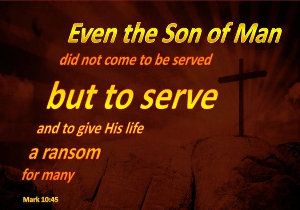
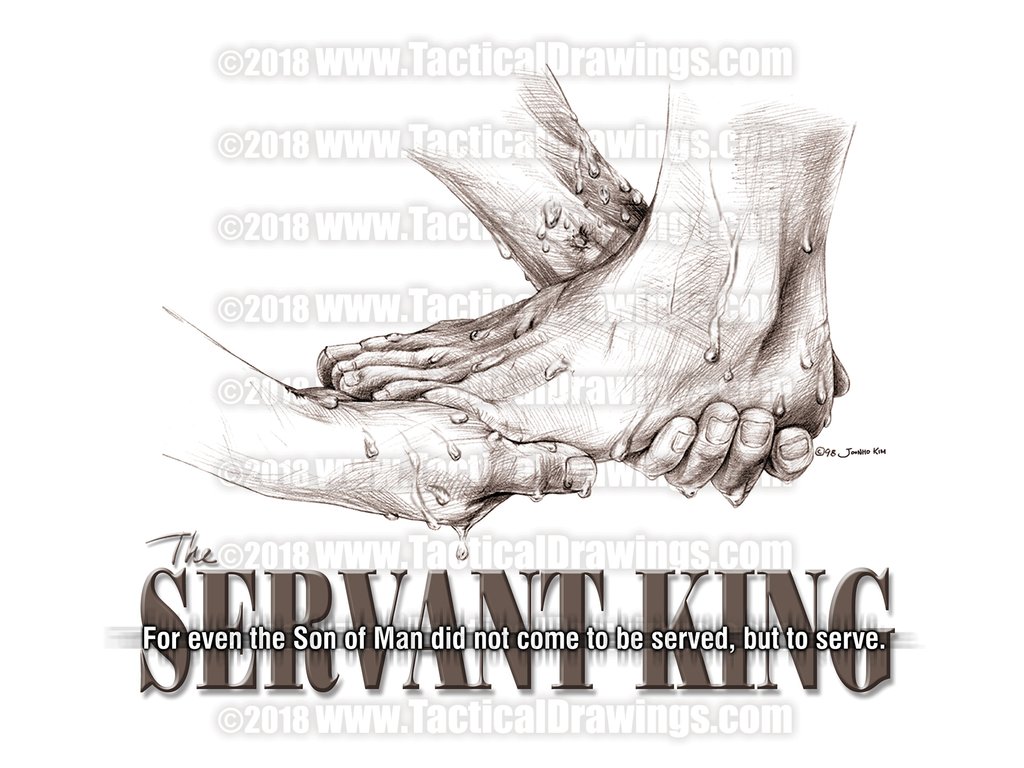
At another time, Jesus said, “Whoever wants to become great among you must be your servant, and whoever wants to be first must be slave of all. For even the Son of Man did not come to be served, but to serve, and to give his life as a ransom for many.” Mk10: 43-45
Jesus called them together and said, “You know that the rulers of the Gentiles lord it over them, and their high officials exercise authority over them. Not so with you. Instead, whoever wants to become great among you must be your servant, andwhoever wants to be first must be your slave just as the Son of Man did not come to be served, but to serve, and to give his life as a ransom for many.” Mt 20:25-28
“My kingdom is not of this world; if it were, My servants (subordinates) would fight to prevent My arrest by the Jews. But now My kingdom is not of this realm.” Jn 18: 36
Not of this realm, not of this world, not a material kingdom made of brick and mortar nor a kingdom of money and possessions but a realm or kingdom of love, agape, the selfless love that gives not expecting any response or recognition. “For whoever would save his life will lose it, but whoever loses his life for my sake will find it.” Mt 16:25
Most Christians are waiting for the return of the Messiah, but Jesus said to his disciples that “the Kingdom of God is in your midst.” Jesus is the Incarnation of the Kingdom! He is the blueprint of that Kingdom. He is the model of what we are to be. To enter the Kingdom here and now we must “sell everything you have and give to the poor.” Jesus is very realistic! “How hard it is for the rich to enter the kingdom of God!” Entering the Kingdom requires total dependence on God, on Abba, the God of Love. It’s not about laws, creeds, rituals, tithing, but about the abandonment of power, fame, and fortune!
The “kingdom of God” is referenced all throughout Scripture. Luke 17:21 tells us the kingdom is in our midst, Matthew 3:2 tells us the kingdom of heaven is near, Matthew 13:41 tell of a “weeding out” of those who cannot enter the kingdom, and Mark 1:14-15 encourages us to repent as God’s kingdom is near. These are just a few of the many scriptures that point to God’s kingdom. The kingdom of God can be described as God’s reign and his rule over all things. God is in charge of our universe. Jesus’ purpose for our world was that we would be a part of his kingdom.
Immediately after his baptism, when God announced that Jesus was his beloved son, Jesus went into the desert to be alone, to pray, and discern what it meant to be a son of God. He did not consider that he was now God rather that he was about to live according to God’s will, or God’s rule, as an embodiment of the Kingdom.
Yet he was challenged by Satan or what some might say his Ego or a new sense of Self. According to biblical scholarship, Satan was the personification of evil or a rebellious attitude or behavior toward God. Luke 4:1-13 describes the threefold temptation of power, fame, and fortune. These have always be considered signs of authority, lordship, and kingdoms.
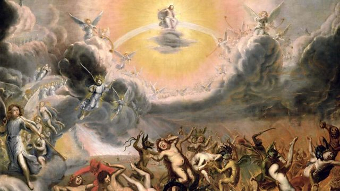
Confusion about the Kingdom of God and the role of the Messiah existed since the beginning of Israel. The coming of the Kingdom was to be the Last Judgement, or in the Christian era, a belief that the coming of the Kingdom of God would put an end to evil. Both these beliefs were widespread and indeed expected.
The people of Israel and the early Christians believed that the history of the world would come to a screeching halt, that God would intervene in the affairs of this planet, overthrow the forces of evil in a cosmic act of judgment and establish his utopian Kingdom on Earth. The concept of a King was what the title Messiah or Savior meant for the Jews.
Apocalyptic or “unveiling” expectations about the judgement and conquering evil began to take root in Judaism when the first temple of Jerusalem was destroyed in 515 BCE and the second in 70 CE. It really begins in the year 586 B.C when the Babylonians, under the famous King Nebuchadnezzar, conquers the city of Jerusalem itself and in the process destroy Solomon’s Temple. It continued and became stronger when the Persian, Alexander the Great, conquered Israel.
“The document known as First Enoch is a series of pseudepigraphal books, most of which are apocalyptic, written in a period when the Jews were ruled by the Greeks. It is narrated by the character Enoch, the seventh patriarch in the book of Genesis, who is believed to be have received visions of secret knowledge from God. First Enoch introduces imagery of angels, heaven, and hell that evolve into common apocalyptic themes in later literature, such as the Book of Revelation. In this excerpt, Enoch describes the fall of the angels who turn away from God, and the judgment of the souls of the dead.” writes Michael White, Professor of Classics and Christian Origins at the University of Texas at Austin. Only now in First Enoch is the rebellion of the angels under their leader, Azazel, whom we’ll later call Satan….So First Enoch gives us some of the most important components of what we think of as later Jewish and Christian apocalyptic traditions. We have God and Satan, good and evil in a battle.” For more details go to: https://www.pbs.org/wgbh/pages/frontline/shows/apocalypse/explanation/jews.html
What happened since the time of Jesus then is a positive or negative reaction to events that are drastic interruptions in the normal affairs of a society. Each generation since that time has been subject to individuals or groups predicting the immediate coming of the end of this world and the coming of the Kingdom of God which will conquer evil for all time. Sometimes there is a split in society with some believing that an event is Apocalyptic and some who refuse to believe such. Both believers and unbelievers react with their own solutions for fighting evil. The concept of a king and his army was paramount to the ability to conquer evil. Thus Jesus is not only the son of God but the King of his followers who become his army. Since Jesus had risen and gone to heaven then another “anointed” person would assume his role.
“For example, in Isaiah, chapters 44 and 45–a portion of the book of Isaiah actually written during the exile itself–we hear of Cyrus the great Persian king referred to as God’s anointed one. The Lord’s Messiah. And it even goes on to say he will be a shepherd for my people. Now, this is God speaking. He, Cyrus, will be a shepherd for my people and he will be the one to rebuild Jerusalem.” …writes Professor White. Today, some evangelicals believe that Donald Trump is the Lord’s Messiah because he is a Republican and claims he is anti-abortion.
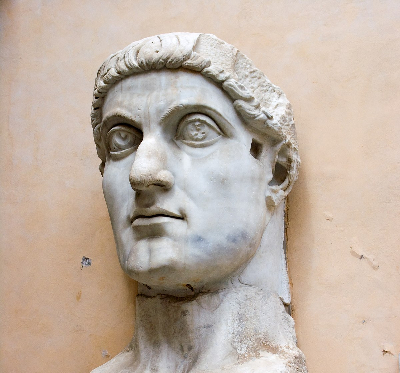
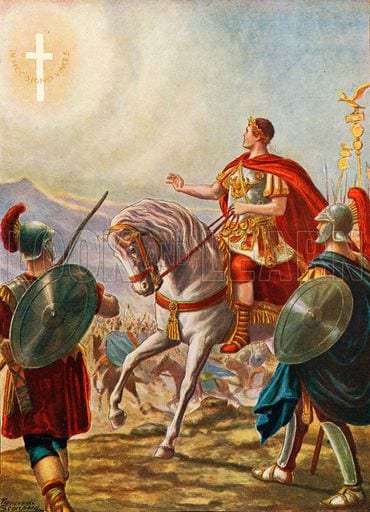
Constantine the Great
In 313 CE, the emperor Constantine was seen by some to be a Messiah because he issued the Edict of Milan, which granted Christianity—as well as most other religions—legal status. … In 380 CE, the emperor Theodosius issued the Edict ofThessalonica, which made Christianity, specifically Nicene Christianity, the official religion of the Roman Empire. These seemed like a victory for good but were they?
This may have been the end of the persecutions against Christianity but it also was the abandonment of the teachings and message of Jesus. Constantine used the sign of the cross as a weapon to defeat the enemies of Rome thus introducing violence as a means of overcoming evil.
This was totally against the teachings of Jesus who taught non-violence. When Jesus was about to be arrested, his “companions reached for his sword, drew it out and struck the servant of the high priest, cutting off his ear.” “Put your sword back in its place,” Jesus said to him, “for all who draw the sword will die by the sword.” Mt 26:51-52
Constantine was a pagan monotheist, a devotee of the sun god Sol Invictus, the unconquered sun. However, before the Milvian Bridge battle, he and his army saw a cross of light in the sky above the sun with words in Greek that are generally translated into Latin as In hoc Signo vinces (‘In this sign conquer). That night Constantine had a dream in which Christ told him he should use the sign of the cross against his enemies. Constantine was seen by many as a possible instrument of God and he was afforded the power to lead the fledgling Christian community so much so that he called the council of Nicea to solve some of the early theological controversies about the nature of Jesus as a human and as God.
At another time Jesus said: “You have heard that it was said to those of old, You shall not murder; and whoever murders will be liable to judgment.’ But I say to you that everyone who is angry with his brother will be liable to judgment; whoever insults his brother will be liable to the council; and whoever says, ‘You fool!’ will be liable to he hell of fire.” Mt 5:21-22
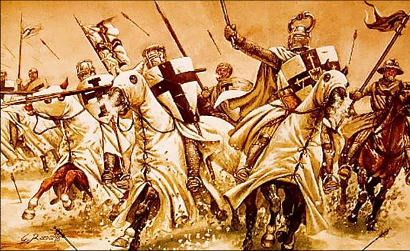
Throughout the early history of Christianity, the Roman Catholic Church used Constantine’s “In hoc Signo vinces” as a rallying cry to overcome infidels and heretics, especially those who did not accept Christianity or those of another religion, like Jews and Muslims. The threat of these numerous unbelievers was seen as another sign of evil that had to be eliminated.
“The Crusades were a series of religious wars initiated, supported, and sometimes directed by the Latin Church in the medieval period. The best known of these Crusades are those to the Holy Land in the period between 1095 and 1291 that were intended to recover Jerusalem and its surrounding area from Islamic rule. Concurrent military activities in the Iberian Peninsula against the Moors (the Reconquista) and in northern Europe against pagan Slavic tribes (the Northern Crusades) also became known as crusades. Through the 15th century, other church-sanctioned crusades were fought against heretical Christian sects, against the Byzantine and Ottoman empires, to combat paganism and heresy, and for political reasons. Unsanctioned by the church, Popular Crusades of ordinary citizens were also frequent. Beginning with the First Crusade which resulted in the recovery of Jerusalem in 1099, dozens of Crusades were fought, providing a focal point of European history for centuries.”
Christian Crusaders
“In 1095, Pope Urban II proclaimed the First Crusade at the Council of Clermont. He encouraged military support for Byzantine emperorAlexios I against the Seljuk Turks and called for an armed pilgrimage to Jerusalem. Across all social strata in western Europe, there was an enthusiastic popular response. The first Crusaders had a variety of motivations, including religious salvation, satisfying feudal obligations, opportunities for renown, and economic or political advantage.”
It’s no wonder then that Jesus is seen as the King of God’s kingdom. For many, this implies conquering the evil in this world by violent force if necessary. Thus the Church on earth is named the “Church Militant”. Such a notion, as we have mentioned, gives people the wrong impression and has done much harm.
Now, in America, we see the Catholic Church and the evangelical Churches waging political anti-abortion wars on those who don’t believe as they do or on those who challenge traditional morality and patriarchy. Truth, integrity, and love are being replaced by weapons of misinformation, propaganda, lies, corruption, and hatred. All this is occurring in the name of Jesus who warned his disciples: “Take heed that no man deceive you. For many shall come in my name, saying, I am Christ; and shall deceive many.” Matthew 24:3-5
Also, Paul wrote in 2 Corinthians 11:12-13 “ I will keep on doing what I am doing, in order to undercut those who want an opportunity to be regarded as our equals in the things of which they boast. For such men are false apostles, deceitful workers, masquerading as apostles of Christ. no marvel; for Satan himself is transformed into an angel of light.”
Jesus- the Servant King
In Matthew 7:20 Jesus says, “Wherefore by their fruits, you shall know them.” What are these fruits? Paul describes them in Galatians 5:22-24 as being the fruit of the Spirit. “But the fruit of the Spirit is love, joy, peace, longsuffering, gentleness, goodness, faith, meekness, temperance: against such there is no law. And they that are Christ’s have crucified the flesh with the affections and lusts.”
Could it be then that what is happening in this age is a battle between Kingdoms? A battle between the ways of this world and the ways of Jesus? Even the Catholic Church and the many evangelical Churches are complicit in succumbing to the ways of the world by engaging in politics, finances, and propaganda. Certain Catholic media are under scrutiny by Pope Francis. EWTN, the Napa Institute, and other such media outlets and groups are known to be actively involved in politics.
Perhaps this is another of those times about which Jesus warns us. Just consider the current amount of hatred and threats of violence and the silence of religious leaders amid the bigotry, lies, and accusations that have become the norm.
All of this is causing division and mistrust which is hardly the fruit of the Holy Spirit.
We must heed the words of Jesus and oppose the evil that encircles us. Truth and Integrity must prevail. The “weapons in this war must be TRUTH and INTEGRITY not violence of any kind. “If you abide in my word, you are truly my disciples, and you will know the truth, and the truth will set you free.” Jn8:31-32
Author Tiffany Shlain offers a practice she calls a “Technology Sabbath” as a way of reducing our addiction to technology and our personal devices. She writes:
How often have you looked up from your screen, eyes dazed, and realized you’ve just wasted thirty minutes or an hour or more? You look around and see everyone else with their heads down staring at their screens, too. You worry about how this is affecting you as an individual and society at large. You think you should do something about it, then your phone buzzes, you respond to the text, and you’re pulled back to the screen again. We’ve become ostriches, burying our heads in silicon sand.
Researchers have compared the sense of technological dependency—the feeling that we must be accessible and responsive at any time—to that of drugs and alcohol. It’s all because of the hormone dopamine, which is related to mood, attention, and desire. When you find something that feels good, dopamine makes you want more of it.
Shlain has creatively adapted the Jewish practice of Sabbath to reduce our dependence on technology. She makes several suggestions for individuals and families to prepare for a day with no devices:
Humans have a proclivity to ban together for many reasons. Being part of a family, tribe, group, or community is a very natural part of being human. The reason for belonging to such groups can be both good for us as well as detrimental. As a member of a family, one can feel secure, cared for, and even loved. This also can apply to almost any kind of group, organization, club, or team. These groups usually have a specific purpose, task, or function. Family and community membership is usually the result of birth or habitat however the former can be the result of adoption and fostering a child or the result of a marriage or remarriage of two adults. The latter group is certainly more versatile and transitory but nevertheless a means of belonging.
Tribes, groups, and communities can be formal or informal, intentional or casual, born into, or a matter of choice. Fellowship is a friendly association, especially with people who share one’s interests. Such associations are freely chosen and freely abandoned without any sense of betrayal yet possibly causing disappointment or sadness. Also, the dynamics of a group can change drastically and frequently. An existing group or team can grow to be intimate, reaffirming, and supportive. But as members leave, the flow or pattern of the group interaction can change from acceptance to avoidance as personalities, trust, and affirmation make all the difference in the growth and development of each member and the bonds of the group or community. Along, with these variables are the relationships that may begin or dissolve due to the absence or presence of certain individuals.
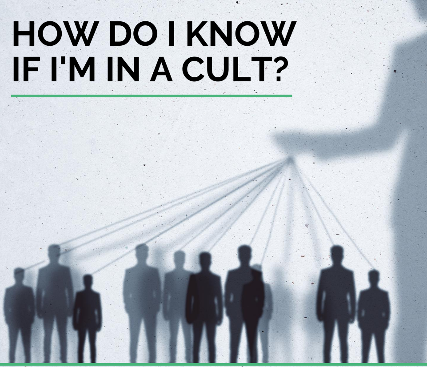
Other groups and communities can be the result of proselytizing, assimilation, or a matter of simply joining for support or protection. Political, religious, and social or cultural groups can result in a variety of cults based on membership and indoctrination or as the result of a powerful and influential personality of the leader who invites individuals to join making that person feel wanted and special.
“In modern English, a cult is a social group that is defined by its unusual religious, spiritual, or philosophical beliefs, or by its common interest in a particular personality, object, or goal.” In many cases “cult” is another name for Religion.
An older sense of the word cult involves can be related to a particular figure and can be associated with a particular place. References to the “cult” of a particular Catholic saint, or the imperial cult of ancient Rome, for example, use this sense of the word.
Groups labeled as “cults” range in size from local groups with a few followers to international organizations with millions of adherents. Certainly, the Catholic Church, like most religions, may be referred to as a cult. The word “religion” is based on the Latin “religare” ‘to bind’, which for my purpose, implies the use of “indoctrination” or the process of teaching a person or group to accept a set of beliefs uncritically.
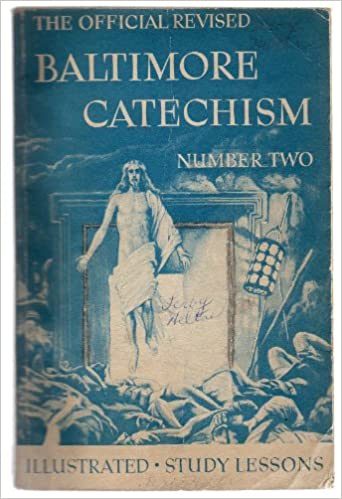
Most older Catholics remember the Baltimore Catechism from grade school religion class. There were questions and answers that every student was required to memorize. For example, a question may be, “Who made the world?” The prescribed answer is “God made the world.” or another question may be, Who is God?” And the answer is, “God is the Creator of heaven and earth, and of all things.”
Explanations for such questions and answers were usually given in Sunday homilies or special meetings for adult education provided by some but not all Catholic parishes.
Like any cult, there was no room for opposing the designated answer and those that did were reprimanded and even ostracised or considered “outside” the Church which, in the history of the Church through the ages, was considered heresy and may have resulted in drastic punishment even death.
Allegiance and complete loyalty to the teachings of the Catholic Church were required at all times and not to be ignored or abandoned. Sure, there were theological and moral disputes throughout the history of the Church as there are today but in the end, they were resolved by dogmatic pronouncements that indicated which definition or theology was correct and which are not. Creeds, Papal Encyclicals, and even Councils spelled out the dogmatic beliefs and ethics and how to apply them. These were not negotiable.
Obviously, cults do not allow any room for dissent or controversy both of which weaken the cohesive bonds of the group and contribute to the identity of the cult’s existance and the validity of its purpose and message. Catholicism, like all serious religions or organizations, have bylaws and statements of goals and purposes. For the Catholic Church, Canon Law and the Catechism of the Catholic Church are two of the many sources of Church laws and teachings in that order. Creeds, doctrines, and dogmas were added as needed to further explain and interpret the Sacred Scriptures. Religion like a cult requires a certain permanent adherence which is usually not easily undone without permission, scorn, or being ostracized.
Tribes are considered to be a political unit formed from an organization of families (including clans and lineages) based on social or ideological solidarity. Membership of a tribe may be understood simplistically as being an identity based on factors such as kinship (“clan”), ethnicity (“race”), language, dwelling place, political group, religious beliefs, oral tradition, and/or cultural practices.“Sometimes, though, the belonging aspect can translate to a sense of “us versus them”. It can create a situation where you view someone who is not of your tribe, team or group as the enemy and the person to be feared.” writes Beverly D. Flaxingtonhttps://www.psychologytoday.com/us/blog/understand-other-people/201809/the-danger-in-belonging
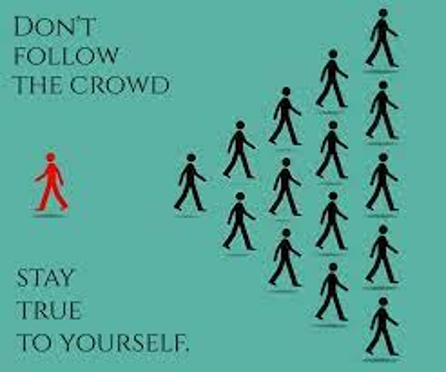
One way to avoid simply following the crowd or community is to use your conscience and then decide whether or not to do as you see fit.
“Conscience is an inner feeling or voice viewed as acting as a guide to the rightness or wrongness of one’s behavior, beliefs, values, or choices. The Catholic Church defines conscience as “a judgment of reason whereby the human person recognizes the moral quality of a concrete act that he is going to perform, is in the process of performing, or has already completed. In all he says and does, man is obliged to follow faithfully what he knows to be just and right. It is by the judgment of his conscience that man perceives and recognizes the prescriptions of the divine law.” #1778 CCC
Therefore, if you are a member of a family, tribe, community, or religious cult, fellowship does not require your allegiance to someone, to some teaching or belief. You are required to listen to and follow your conscience.
“Conscience is a law of the mind; yet [Christians] would not grant that it is nothing more; I mean that it was not a dictate, nor conveyed the notion of responsibility, of duty, of a threat and a promise. . . . [Conscience] is a messenger of him, who, both in nature and in grace, speaks to us behind a veil, and teaches and rules us by his representatives. Conscience is the aboriginal Vicar of Christ” claims John Henry Cardinal Newman, in Letter to the Duke of Norfolk. “It is important for every person to be sufficiently present to himself in order to hear and follow the voice of his conscience. This requirement of interiority is all the more necessary as life often distracts us from any reflection, self-examination or introspection.” #1779 CCC
However, one must consider the role of virtue, education, and experience in the formation of one’s conscience. Conscience is not to be confused with desire, habit, or any other predisposition that may influence one’s decision to take or not take a particular action.
“The education of the conscience is a lifelong task. From the earliest years, it awakens the child to the knowledge and practice of the interior law recognized by conscience. Prudent education teaches virtue; it prevents or cures fear, selfishness and pride, resentment arising from guilt, and feelings of complacency, born of human weakness and faults. The education of the conscience guarantees freedom and engenders peace of heart.” #1784 CCC
For the Christian, Koinonia refers to concepts such as fellowship, joint participation, the share which one has in anything, a gift jointly contributed, a collection, a contribution. It identifies the idealized state of fellowship and unity that should exist within the Christian church, the Body of Christ. The term may have been borrowed from the early Epicureans—as it is used by Epicurus’ Principal Doctrines.
The word appears 19 times in most editions of the Greek New Testament. In the New American Standard Bible, it is translated “fellowship” twelve times, “sharing” three times, and “participation” and “contribution” twice each.Koinonia appears nowhere in the ancient Greek translation of the Old Testament known as the Septuagint.
The Eucharist is the sacrament of communion with one another in the one body of Christ. This was the full meaning of eucharistic koinonia in the early Catholic Church. St. Thomas Aquinas wrote, “the Eucharist is the sacrament of the unity of the Church, which results from the fact that many are one in Christ.” Yet other denominations of Christianity consider the New Testament description of fellowship as described in the book of Acts: “They devoted themselves to the apostles’ teaching and to the fellowship, to the breaking of bread and to prayer. … All the believers were together and had everything in common. Selling their possessions and goods, they gave to anyone as he had need. Every day they continued to meet together in the temple courts. They broke bread in their homes and ate together with glad and sincere hearts, praising God and enjoying the favor of all the people” (Acts 2:42-47)
According to the International Journal for Pastors “Christian fellowship is vertical as well as horizontal. The horizontal plane presupposes the vertical for its very existence. John described the vertical dimension this way: “Our fellowship is with the Father and with his Son, Jesus Christ” (1 John 1:3). This fellowship is what makes a Christian, Christian. Indeed, John’s words provide a definition of what it is to be Christian. Those not in fellowship with the Father and the Son, however upright they may be, are not actually Christian in this Johanine sense. The horizontal dimension of fellowship is the habitual sharing, the constant giving to and receiving from each other, which is the true, authentic pattern of life for God’s people. Fellowship with God, then, is the source from which fellowship among Christians springs; and again, fellowship with God is the end to which Christian fellowship leads.”
True Christian fellowship, like a true Christian conscience, must be open to the Grace of God, to pure goodness, and in keeping with Christian virtue all of which comes to us in and by the power of the Holy Spirit.
Certainly, the basic foundation upon which fellowship and conscience exist is the Word of God and prayer. “Discernment has steps that can be taken in order to achieve a level of discernment. The following actions can be made when making decisions of discernment; taking time in making decisions, using both the head and heart, and assessing important values involved in the situation. Time has been considered necessary in the process of making a smart choice and decisions made in a hurry can be altered by lack of contemplation.”
“The focus on God and Jesus when making decisions is what separates Christian discernment from secular discernment. Ignatius of Loyola is often regarded as the master of the discernment of spirits.Ignatian discernment comes from Ignatius of Loyola (1491-1556) when he created his own unique way of Catholic discernment. Ignatian discernment uses a series of Spiritual Exercises for discerning life choices and focuses on noticing God in all aspects of life. The Spiritual Exercises are designed to help people who are facing a major life decision. There are seven steps of discernment to be followed that include identifying the issue, taking time to pray about the choice, making a wholehearted decision, discussing the choice with a mentor and then finally trusting the decision made.”
“Lectio Divina is another means of informing oneself about decisions pertaining to conscience and fellowship. It has been likened to “feasting on the Word”: first, the taking of a bite (lectio); then chewing on it (meditatio); savoring its essence (oratio) and, finally, “digesting” it and making it a part of the body (contemplatio).In Christian teachings, this form of meditative prayer leads to an increased knowledge of Christ.”
Therefore, just because one belongs to a family, tribe, cult, community, or religious group, one shouldn’t merely “follow” the crowd but genuinely discern whether one should or not accept the teachings, ideas, rituals, traditions, or requirements of any of the above. Instead, for the Christian, true membership or fellowship is built upon the Way, the Truth, and the Life of Jesus.
Thus a few caveats are in order: Genuine fellowship has enemies: the self and the shadow or dark side of the self. James asks: “What causes fights and quarrels among you? Don’t they come from the desires that battle within you?” (James 4:1).
We must also remind ourselves that each person must follow their own conscience which means that we are not in the position to condemn or judge another. For Paul writes: “You, therefore, have no excuse, you who pass judgment on someone else, for at whatever point you judge the other, you are condemning your self, because you who pass judgment do the same things” (Rom. 2:1).
In its most basic sense, a saint is a “holy one,” someone who is set apart for God’s special purposes. As a result, every follower of Jesus Christ is a saint.From the collection ofWorld Menagerie
The English word saint comes from the Latin sanctus, with the Greek equivalent being ἅγιος (hagios) ‘holy’.[6] The word ἅγιος appears 229 times in the Greek New Testament. The word sanctus was originally a technical one in ancient Roman religion, but due to its globalized use in Christianity the modern word saint is now also used as a translation of comparable terms for persons “worthy of veneration for their holiness or sanctity” in other religions.
According to the Catholic Church, a saint is anyone in Heaven, whether recognized on Earth or not, who form the “great cloud of witnesses” (Hebrews 12:1).[10][11] These “may include our own mothers, grandmothers or other loved ones (cf. 2 Tim 1:5)” who may have not always lived perfect lives, but “amid their faults and failings they kept moving forward and proved pleasing to the Lord”.[10] The title Saint denotes a person who has been formally canonized—that is, officially and authoritatively declared a saint, by the Church as holder of the Keys of the Kingdom of Heaven, and is therefore believed to be in Heaven by the grace of God. There are many persons that the Church believes to be in Heaven who have not been formally canonized and who are otherwise titled saints because of the fame of their holiness.[12]
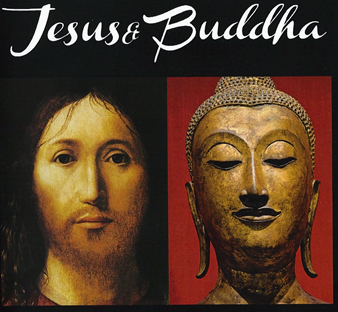
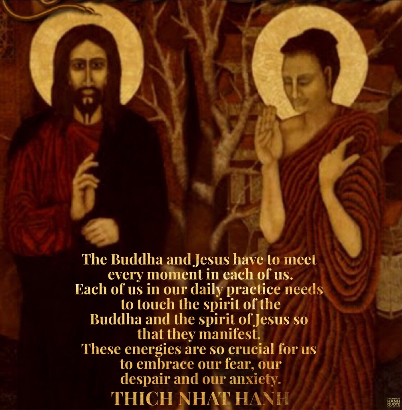
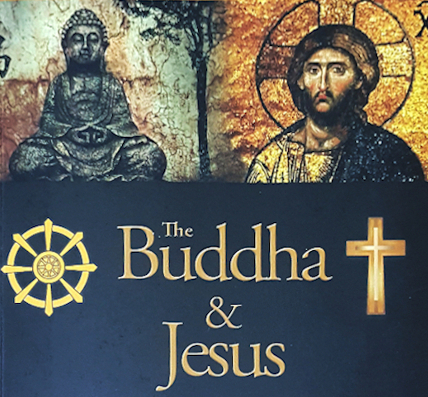
Both taught a religion of the heart, everlasting virtue, the way to generosity and the value of faith, serenity, and compassion.
Jesus and Buddha would recognize themselves in each other.
Both underwent life altering experiences that enlightened them and inspired them to share their insights, and wisdom with everyone they met.
Jesus found his true Self in the desert and Buddha was enlightened under the Bo tree.
Both discovered a new way of understanding themselves and the way they saw life. Jesus offered himself as THE WAY and Buddha found THE PATH.
Buddha taught the Four Noble Truths that comprise the essence of Buddha’s teachings, though they leave much left unexplained. They arethe truth of suffering, the truth of the cause of suffering, the truth of the end of suffering, and the truth of the path that leads to the end of sufferingwhich the Buddha taught as the EIGHT-FOLD PATH.
Jesus taught the eight Beatitudes, the three fold commandment of LOVE called Agape, the essence of humility as the means to fulfillment, and the confidence needed for well-being.
Jesus said: “Do to others as you would have them do to you.”
Buddha said: “Consider others as yourself.”
Jesus said:“Your father in heaven makes his sun rise on the evil and on the good, and sends rain on the righteous and on the unrighteous.”
Buddha said: “The grace cloud rains down on all whether theri nature is superior or inferior. The light of the sun and the moon illuminates the whole world, both him who does well and him who does ill, both him who stands high and him who stands low.”
Jesus said: “Out of the heart come evil intentions, murder, adultery, fornication, theft, false witness, slander. These are what defile a person, but to eat with unwashed hands does not defile.”
Buddha said: “One does not become pure by washing, as do the multitude of mortals in this world; he who casts away every sin, great and small, he is a brahim who has cast off sin.”
My Time after the Council Part 4 Executing the Council leads to an execution!
by Dr. Anthony Massimini, Ph.D.
Preparing to Return to Philadelphia
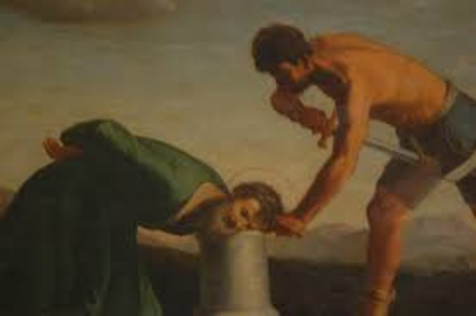
The Beheading of St. Paul in Rome
A week or so after Kennedy’s visit, I defended my dissertation and was awarded my Doctor’s degree. It was time to go home. Bill Leahy and I booked passage on the S. S. Independence. (He would return again for the remaining council sessions.) Just before we left, our classmates warned us. “You two are thinking of going home to Philadelphia and talking about the “New Pentecost.” You know what’s going to happen to you? The same thing that happened to St. Paul when he came to Rome. You’re going to get your heads chopped off.”
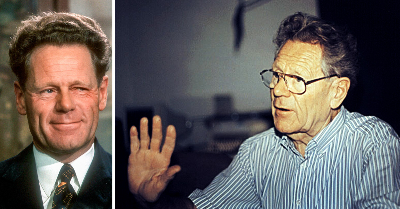
We laughed. But we shouldn’t have. This wasn’t the first time we were warned. During the council’s first session, Bill Leahy had invited theologian/peritus Hans Kung to the graduate house for an informal talk session. I clearly remember the contrast between his rugged features and twinkling eyes. Even more so, I remember my naive surprise to hear him criticize the Curia. He noted that the Curia was upset because they were losing control of the council. Wishing they had more time to ensure their control, they were now complaining that the council was being held too soon. Kung smiled and said, “My response is that the council is being held 400 years too late.”
Theologian/peritus Hans Kung
He went on to say that we should not force the Protestants to give up their beliefs and principles for the sake of reunion with Rome. It’s too much to ask people to give up principles they firmly believe in. The way to reunion was not a return to Rome but a return to Christ. “I say to the Protestants, ‘You come closer to Christ your way, and we’ll come closer to Christ our way. Some day we’ll meet in Christ.”
The next day, Bill Leahy suggested that I write an article on what Kung had said. I did so and then brought it to the place where Archbishop Krol was staying, to get his prior approval before sending it for possible publication somewhere. He wasn’t there so I left the article. The next morning, Krol was in the pulpit making the announcements that opened each council session. When he finished, he called me over and said, “We’re going to lunch.”
A little after noon, Krol and I walked out of St. Peter’s, turned left through the Bernini colonnade and found a little trattoria. As we started to eat, he said, “I read your article. First of all, there is nothing new happening at the council.” I thought of Cardinal Ottaviani’s coat of arms, which contains the words, “Semper Idem,” Always the Same. “And,” Krol continued, “there are no arguments going on. Everything is going along well. There are no disagreements at the
council.
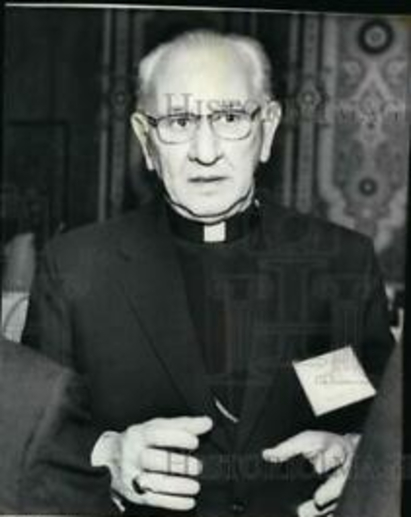
Cardinal John Krol
Naively, I protested, “But there are disagreements. The church is going to change and the people back home should be prepared for the changes.”
Krol would have none of it. “The church is one. After the council the church will still be the same as it was before. And I don’t want you having anything to do with this Hans Kung or any others who are stirring up dissention. When you get back to Philadelphia, I don’t want you telling people that there are disagreements. I want you to present the church just as the authorities say it is.”
Back at the graduate house I told Leahy what had happened. He said, “Well, now we know for sure where we stand. We’re alone.”
Years later, I told this story to the National Catholic Reporter and it was included in an extensive report on the Archdiocese of Philadelphia. I ended my story by saying that the only good thing that happened that day was that Krol paid for my lunch.
So here we were, being warned again. Nevertheless, we were going home with high hopes.
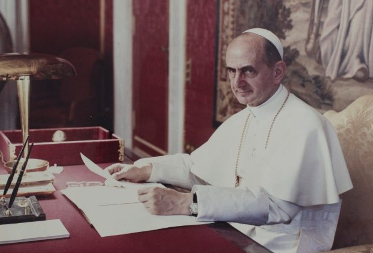
Pope Paul VI
On the ship Bill Leahy and I discussed Pope Paul VI’s election. The story was that Paul was supposed to be Pius XII’s immediate successor. But Pius had failed to make him a Cardinal, so John XXIII was chosen as an interim. After all, the jolly old man would die quickly without doing anything notable, except naming Montini a Cardinal so he could become pope. Yet, during the council’s first session, Montini showed some progressive tendencies which caused the Curia some concern. They would have to control him.
Controlling Paul would be easy. He was known to have difficulty making up his mind. He even had a nick-name, “Hamlet.” “To be or not to be”, was seen as his motto. Another of his nick-names was, “The Frenchman.” He preferred reading French literature, including French Existentialists like Sartre and Camus., who wrote about the anguish of existence. Yes, he could be handled.
The Spirit was “Blowing in the Wind”
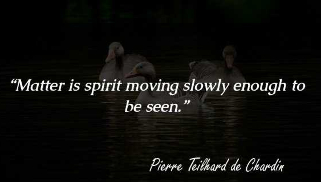
We excitedly prepared to present the “New Pentecost” to Philadelphia, to show how Pope John XXIII had opened the windows of the church and how the Spirit of renewal and hope was flying freely. I added my new-found wonder over the spiritual vision of Teilhard de Chardin, whose teaching of the “Within” especially captured my imagination.
Since I was a public school graduate, my Theology courses at the Gregorian University were my introduction to the teachings of the church. And there, one day I learned that the Kingdom of God was not only something we would enter into after we die but was already here on earth, in space/time, in an incipient form. When I heard the professor say that, I saw the whole world suddenly light up. God was here! Here on earth! Here within us! Within everyone and everything! God within all! The whole world was a union of God and nature, God and us. The whole world was truly an expression of Christ.
De Chardin was saying the same thing in a very beautiful way! And the council was saying it too. The new liturgy was truly the prayer of the People of God here on earth. The “New Pentecost” was off to a great start. The Spirit was blowing where she would! Bill and I had so much to tell the people of Philly! Then we remembered the warnings. Would anybody listen to us? What would happen? Where would all this lead us?
From the music in the ship’s lounge came a new and strange message, “The answer, my friend, is blowin’ in the wind.” I immediately knew that the answer was the Spirit.
Opposition to Vatican II
Many people blame Vatican II for the negative changes the church and our culture experienced in the 1960’s and beyond, e.g., the breakdown of traditional family life, the hippies, the sexual revolution, and the disaffection that caused so many Catholics to walk away from the church. The truth is just the opposite. Vatican II foresaw major changes coming, along with great opportunities, and showed Catholics how to handle these changes and take advantage of the opportunities actively and successfully.
Others had also seen changes coming. In 1945, as the atom bomb exploded over Hiroshima, Albert Einstein prophetically said, “Everything has changed, except our way of thinking.” Some 20 years earlier the mystical poet, W. B. Yeats, had written concerning the 20th century, “Things fall apart, the centre cannot hold: Mere anarchy is loosed upon the world… …The best lack all conviction, while the worst are full of passionate intensity. Then he added, “Surely some new revelation is at hand.” Teilhard de Chardin had said that the Modern World was dying, not by accident but because its aberrations were built right into it. “A new kind of life is starting,” he said.
After World War II, Catholics began moving out of the big cities, where many of them lived on “Catholic islands” that took care of all their religious and social needs, and which they left only to go to work. On the “island” the faith was everywhere and moral behavior was built right into the social structure. Then, when they moved away into an open culture where neighbors weren’t all Catholic or of the same ethnic heritage, they were challenged to change from their “island” mindset to an active, self-responsible and more spiritually mature life of faith.
To help Catholics live in the new world that was dawning, Vatican II’s Constitution on the Church was telling them that they had their own individual vocations, and that they were able to discern God’s presence and intentions within themselves, and that they were spiritually empowered and responsible as sharers in Christ’s prophetic and kingly office to uplift and even correct their new environment in the grace of Christ, without imposing their faith on anyone. (See the various pages in this blog.)
Catholics were being told that they were all receivers of God’s revelation and that their belief was an essential part, along with the belief of the theologians and bishops and pope, of the church’s understanding of faith and morality.
But the distance between the bishops and the laity was too great. Even with the good will that the bishops took home with them after the Council ended, they were not prepared to properly inform the laity and form them into spiritually mature and effective Catholics. Through the years, that distance has grown and the situation has worsened. This is one reason why many Catholics have walked away from the church. As Hans Kung predicted, there would be no big revolution among the Catholic laity, just a quiet walking away.
Clarifying the Council’s Purposes
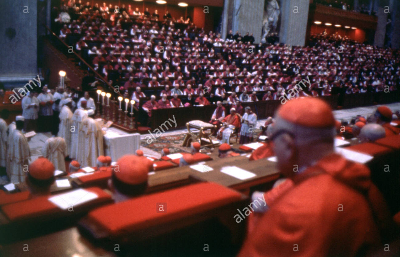
When Pope John XXIII died, the council was automatically suspended. It could have died with him. But Paul VI chose to continue it.
Pope Paul VI attending Mass at the Council
John’s call for a pastoral council and for aggiornamento was vague, so Paul made the council’s purposes clearer by setting four priorities:
1. The church would understand itself more clearly.
2. The church would reform itself in line with its updated understanding of itself.
3. Ecumenism, especially working toward the unity of all Christians.
4. Dialogue with the everyday world.
With these priorities in mind the council went to work on the schema that became the Constitution on the Church, which can be considered the council’s basic document, out of which all the other documents arise. During the intermission, the commission on the church, along with its theologians, had re-written the Curia’s old schema (which John XXIII had rejected). The council fathers now voted to accept this new Schema for discussion by 2231 to 70. Yet there were some strong disagreements to follow.
One major understanding of the church that the council changed was the apologetic, or defensive, understanding. The Council of Trent, that followed upon the Reformation, had explained the church and its teachings in strong, defensive language, saying that if anyone disagreed, Anathema sit! Let him go to hell! In my course on the church at the Gregorian University, just about every lecture began, “The Protestants teach so and so, but we teach so and so.” In those days we could say that if it hadn’t been for the Reformation, we wouldn’t know who we were.
Re-envisioning the Church
Vatican II began its updated understanding of the church by placing the focus not on the church itself but on Christ as founder and head of the church. “Christ is the light of all nations,” the document begins. Then the council went beyond all literal fundamentalism by declaring that the church is a Mystery. That doesn’t mean that the church is something we can’t understand at all, but that it is a reality whose understanding is inexhaustible. Founded by Christ, it shares in the inexhaustible fullness of reality that is Christ, and that is God and the Trinity, and even the Mystery of creation itself.
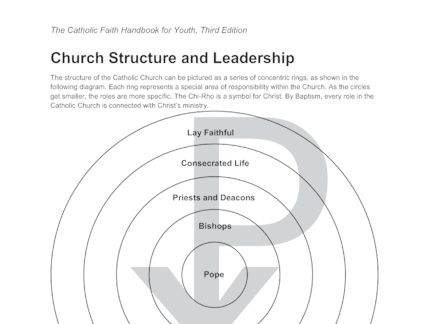
The council then moved from the pyramid view of the church, with the pope on top, the bishops under him, then the clergy, and then the laity on the bottom. We are a People, the People of God, a family, a circle of believers. All share equal baptismal dignity. Among us, some are ordained for service-leadership.
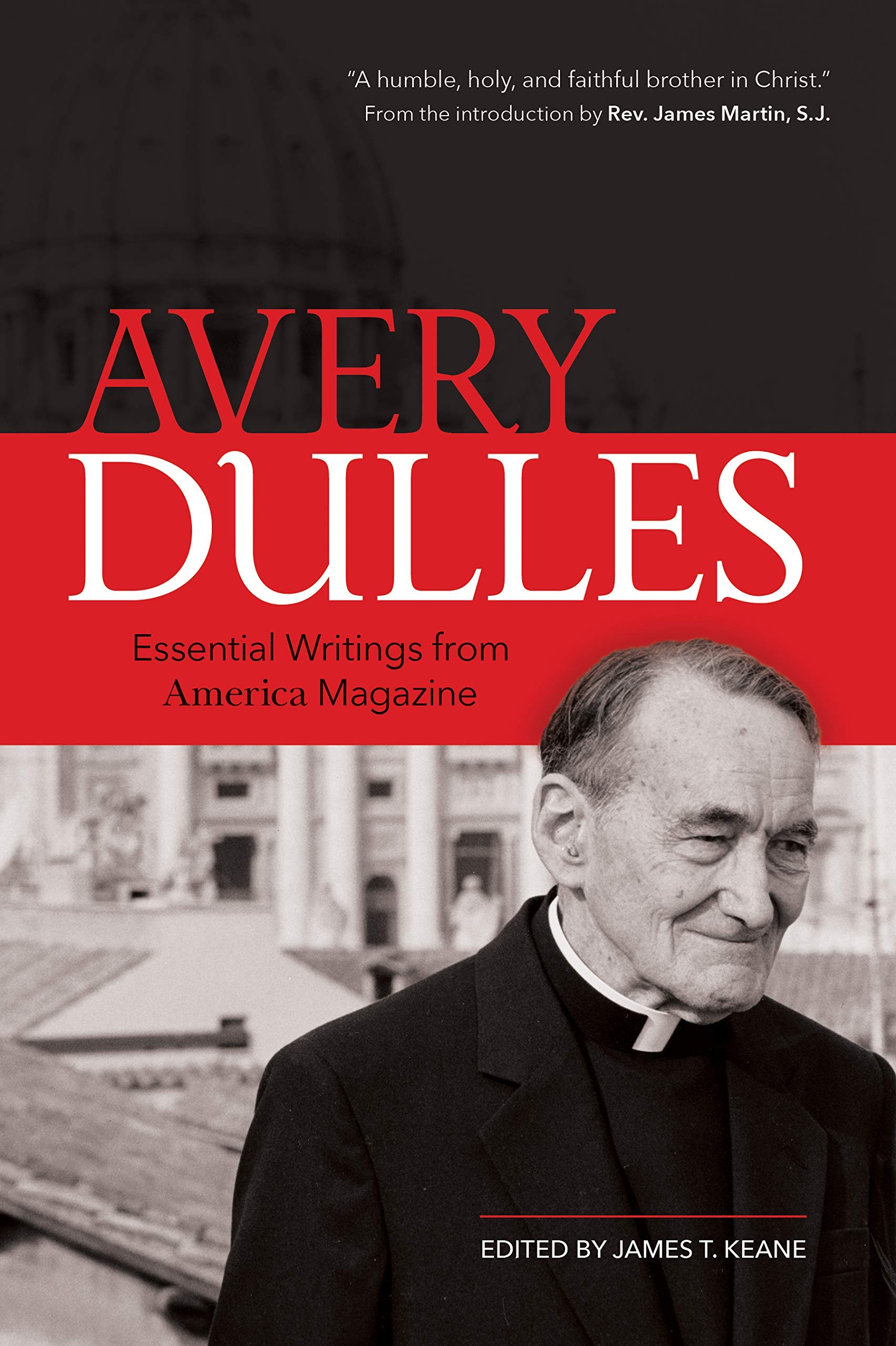
The new understanding influenced Cardinal Avery Dulles, who later wrote about the models of the church. He said that the church is a:
a. Mystical Communion: people united in their faith and in the Spirit of Christ
b. Sacrament: the sign of God’s presence in the world
c. Herald: the proclaimer of the Good New of Christ to the world
d. Servant: the humble sharer in the concerns of the people of the world
e. An Organization: a visible structure
Dulles said that the Organization should not be the first model when we understand the church.
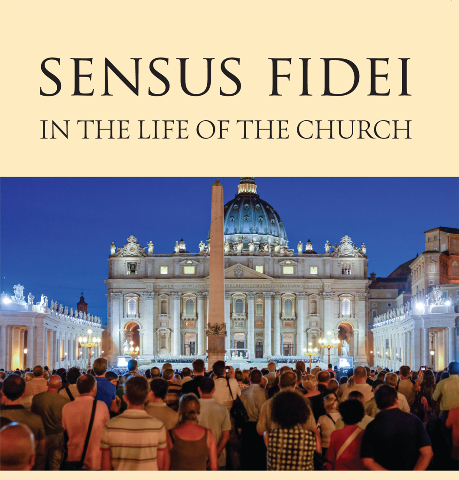
The council then took up the teaching on the sensus fidelium, a teaching that still divides Catholics today. We will discuss it next time.
The Sensus Fidelium: the whole Church’s “instinct” for the Truth of our Faith
The sensus fidelium is a very important key to seeing what the church would be like today if Vatican II had been fully implemented. We will discuss it in the next few entries.
We go to school and choose careers. Many of us get married and have children. We vote for this or that candidate. We work or run businesses. Some of us provide services, e.g., plumbing, roofing, legal services, health services, etc. Some study the universe. Some are artists. We all watch TV and movies. We pray. Etc., etc.
Q. Which of the above pertain to our spiritual life?
A. All of them.
By believing in God, we are personally responding to God’s self-communication to us. God literally gives himself to us and the Spirit of Christ comes to dwell within us. We respond to God’s self-gift by saying, “I believe in You.” This first moment of our personal relationship with God is also the first moment of our spiritual enlightenment and understanding. This moment is followed by a steady stream of evolving understanding.
As we grow in our lives and in our faith, our relationship with God in faith–our loving friendship with God–grows. In this wondrous friendship, our understanding of God and ourselves grows in clarity and sensitivity. We can tell ever more clearly and effectively when our life is “in sync” with God’s intentions for us and when it is not. We develop a “sense’ or “instinct” for God and God’s intentions. This is our personal “sense of faith,” in Latin, sensus fidei. It is our individual participation is the sense of the faith of the whole church, in Latin, the sensus fidelium.
Our sense of the faith is involved when we successfully choose what we want to study, whom we marry, whom we vote for, etc. It makes our everyday experience make faith-sense, i.e., it shows us that our everyday choices and actions are in accord with our faith. It also puts our faith in sync with our everyday experiences and choices, i.e., it shows that our faith is correctly animating and influencing our everyday experiences and choices. In both ways, we are elevated to a higher plane toward the “life in abundance” that Christ brings us.
Today, our experiences and choices involve some very controversial issues of faith and morals, e.g., freedom of religion in our American society, contraception, women’s rights, war, etc. Everyone of us is making decisions in these areas as part of today’s spiritual journey. By “decisions,” I don’t mean political or cultural opinions, but true discernment within our personal relationship with God. At this deep and sensitive level, our own everyday experiences and choices would ideally be in sync with our faith. But how do we know we are right? How do we know that our individual sense of the faith is correct?
No one in the church has the truth all by themselves, not even the pope. We all know the truth by sharing our individual sense of the faith with the faith of the whole church. How do we do this? Vatican II taught that there should be an open and free discussion among the laity, theologians and hierarchy, so that we could correctly “test the Spirit,” in matters that concern today’s life and choices. But as I noted in an earlier post in this diary, there are forces in the church at the highest level that do not want this openness among the hierarchy, theologians and laity. One result is that, some years ago, a group of American bishops publicly admitted that they are not set up to discern the faith of the people. That makes things more difficult for us because, in many ways, we’re on our own.
Lay Initiative
Certainly, there are individual bishops who would like to listen to the laity and guide us in our sense of the faith. But they are constrained by their many “church-organization” duties. Many, too, are not theologically up to date. So we have to listen to what the bishops say, and then judge what part of it is of their determination to regain the power and credibility that they have lost, and what is of God.
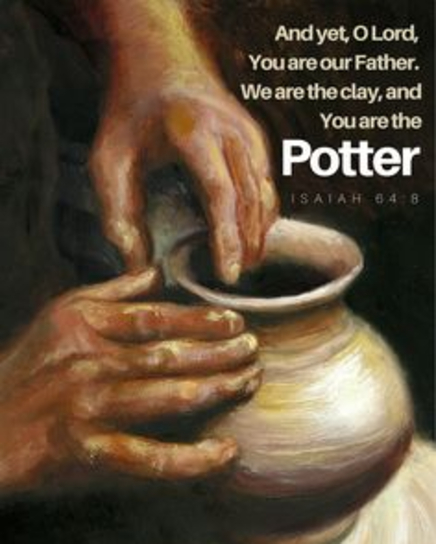
In the meantime, we can operate on our own initiative. Our sense of the faith is alive. Being alive, it grows and evolves as we grow and evolve. So, to begin with, we have to check out our idea of God to make sure our sense of the faith is truly up to date, that it fits our life in today’s society and culture. Ask yourself, “How would I describe God?” There are very, very many ways to describe God, some good and some that are out of date and therefore obstacles between God and ourselves. For example, Genesis describes God as a potter, who picks up red clay, (in Hebrew, adam), forms it in his hand, and then breathes life into it. This is a beautiful image, unless we take adam as Adam, a particular man, who actually lived in a garden with Eve and a snake. Psalm 23 describes God as our Shepherd. Again beautiful, unless we think of ourselves as passive sheep. The Middle Ages gave us Michelangelo’s view of God as an old man with a beard flying in the sky. Magnificent, but of course, correct only artistically. Many of us were taught to describe God as the Supreme Being, living “up there” in heaven as a king, running the universe at his will, and from time to time miraculously changing the way nature works. This image is an obstacle to today’s sense of the faith.
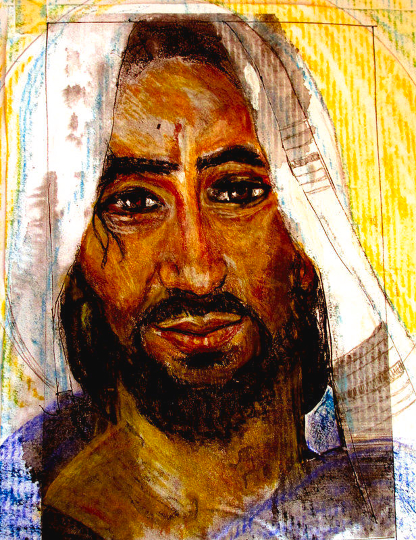
Our best image of God begins with Jesus. We look at him and in him, with the eyes of faith, we see God. We see in Jesus his humanity, which is part of our nature; and we see in him, God who is present and active, right here, right now, in our everyday world and in our everyday lives–on our everyday terms. This is the God whom Jesus has given to us, a God, who is present within the entire world and earth, joyfully watching creation evolve through all its wonderful ways. This is a God, who is personally dwelling within each of us, animating and encouraging us to express him by living our lives in creative, healing and world-transforming love. Our sense of faith then, operates within our deeply personal relationship with God, living and active within us here and now, in everything we think, decide and do every day. It is within this view of God that we develop our sense of faith and determine that our everyday thoughts and actions are in sync with our faith, and that our faith is in sync with out everyday thoughts and actions.
Seeing How Our Faith Helps Form Our Everyday Experiences
Our sense of the faith is very closely related to, “Contemplation in Action”, which I describe on the “Prayer” page. We literally take God with us everywhere we go and in everything we do. As spiritual writers say, we don’t see God directly, we “catch sight of God out of the corner of our eye.” The question is, how clearly and effectively do we “see” God within us, and how clearly and effectively does God “show forth” where we are and in what we do?” In other words, “How do we see our faith forming our everyday experience, and how does our everyday experience show forth our faith?
When the sense of faith shows forth in us, God is “magnified” and shines through here and now in space/time. This applies to both general and particular situations. Here are some general examples of how, to people of faith, God showed forth and shows forth today :
–when Rosa Parks refused to sit in the back of the bus
–when Dr. Martin Luther King, Jr., preached civil rights for African Americans and by extension, for all Americans
–in the government’s attempt to get health care for as many Americans as possible (how this is done in open to discussion)
–in the continuing advances in science and in medical care
–in the Arab Spring
–our American freedoms, and our traditional youthful optimism and sense of fairness
Within the church community:
–when the bishops of Central and South America declared that the Gospel demands that we show a preferential option for the poor and oppressed
–in the 1980’s when the American bishops wrote their excellent papers on Peace and on the Economy
–Catholic Charities
–the up-to-date, effective spiritual work of nuns
–in Vatican II and the laity’s increasing desire to learn how to apply their faith to their everyday lives and situations
When the sense of the faith is missing, the Spirit is denied and God is hidden or even mocked. Here are some examples:
–the Iraq invasion and war, which Pope John Paul II declared to be immoral and unjustified
–the incompetence and greed that caused our economic recession
–our present political inability to get anything done
–ecological pollution, continuing racism and sexism
–the decline of education, and the political and economic attacks on our schools
–the hypocrisy and hatred spewed by some politicians, radio and TV commentators, and writers, and the fact that so many people believe what is being said
–our almost pathological, “Me first!” and even, “Me only!” individualism, and killing competition. Our consumerism and shallowness.
Within the church community:
–the horrific damage done to innocent children and to the whole church and society by the sex abuse and its on-going cover-up
–the inability or refusal of church officials to replace the present corrupt authority system with a system that permits the Spirit to fly free throughout the church
–the passivity and apathy of many of the laity
–the anger and hatred expressed by some Catholics in defense of “the church” as they see it
These general examples give us the context and culture within which we live our individual spiritual lives. At times, the outlook seems daunting. But the sense of the faith tells us that God is with us. In the next entry, we will begin to look at the various aspects of our individual sense of the faith.
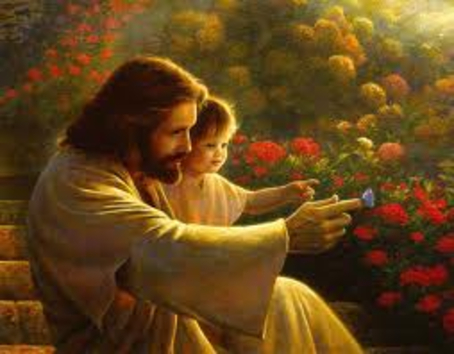
Here’s one way to experience your sense of the faith. Look at a child. Imagine that the child is made of energy. Now turn that energy into light, and imagine that the child is made of light. Now imagine an even greater light shining within the child, filling him or her completely. Imagine that that light is God. Now imagine that at every point where the brighter light is touching the lesser light, that touch is immaculate. You now have a picture of a child who is a luminous expression of Christ. Your ability to see the child that way is part of the gift of faith that God has given you. (Our faith also tells us that as we grow older, we inevitably add some darkness that tends to cover over the immaculate touch within us. But that immaculate touch is never lost. It also is there, inspiring us forward and even, when necessary, “burning,” us to repent.)
Now imagine that God is speaking to that child from within. God is calling the child to ever fuller and greater life. Since God lives in eternity, we can say that God is calling that child not only in the present but also from the child’s future. That child is yours and you are responsible to help the child respond to God’s call to become all that they are destined to become.
As you form that child in Christ, you will also form yourself in Christ.
And he said: “Truly I tell you, unless you change and become like little children, you will never enter the kingdom of heaven. Mt 18:3
Dr. Anthony Massimini, Ph.D.
Ordained for Archdiocese of Philadelphia, Rome, 1959
Attended first session of Vatican II, 1962
Dispensed by Pope Paul VI in 1971 and returned to the laity
Married in a Catholic ceremony, 1972
Editor and Translator: Council Speeches, Third Session of Vatican II, with William K. Leahy
Author: The New Dance of Christ–Discovering Our Spiritual Self in a New, Evolving World, Xlibris Publishers, 2000








 Faith Seeking Understanding