Justice for Planet Earth – A non- political Issue for the American Catholic Bishops

Voices all over the earth are crying out for justice and freedom! Too many dictators are popping up like weeds invading a garden; only the garden happens to be the planet. As of today, there are 50 dictatorships in the world (19 in Sub-Saharan Africa, 12 in the Middle East and North Africa, 8 in Asia-Pacific, 7 in Eurasia, 3 in Americas and 1 in Europe). America is trending toward autocracy so we just might be joining the 50 club! This has grave implications for our future on many levels.

Speaking of gardens, Mother earth is also crying out for justice and freedom! Extreme weather events are impacting cities, farms, and all sorts of habitats. Extreme heat and cold in areas that are not prone to such weather can  increase waterborne diseases, poor air quality, and diseases transmitted by insects and rodents. 

Climate change impacts many of the essential aspects of our lives on the planet. “Things that we depend upon and value — water, energy, transportation, wildlife, agriculture, ecosystems, and human health — are experiencing the effects of a changing climate…Because the ocean absorbs about 30% of the carbon dioxide that is released into the atmosphere from the burning of fossil fuels, the ocean is becoming more acidic, affecting marine life. Rising sea levels due to thermal expansion and melting land ice sheets and glaciers put coastal areas at greater risk of erosion and storm surge.”

If you go to most populated shore areas, like the ones in southern New Jersey, you know that the size of dunes are getting wider and higher and the land between the ocean and the bays is shrinking. Flooding there has become common place after slightly abnormal amounts of rain.

Real estate is booming there and all around the major cities and the stress of traffic and tourism is causing more fossil fuel pollution and the need for more landfills to dispose of all the trash that will take centuries to decompose. Landfills are also required by the EPA to monitor non-methane organic compounds that are in the gases that escape into the atmosphere. These compounds can cause smog and other health problems for people and animals that live nearby. The Covid virus proved to be a great threat to those people with respiratory and heart issues.

In his encyclical letter, Laudato Si, on care for our common home , Pope Francis writes: “Saint Francis of Assisi reminds us that our common home is like a sister with whom we share our life and a beautiful mother who opens her arms to embrace us. “Praise be to you, my Lord, through our Sister, Mother Earth, who sustains and governs us, and who produces various fruit with coloured flowers and herbs.This sister now cries out to us because of the harm we have inflicted on her by our irresponsible use and abuse of the goods with which God has endowed her.”

He goes on in paragraph 8: “The continued acceleration of changes affecting humanity and the planet is coupled today with a more intensified pace of life and work which might be called “rapidification”. Although change is part of the working of complex systems, the speed with which human activity has developed contrasts with the naturally slow pace of biological evolution. Moreover, the goals of this rapid and constant change are not necessarily geared to the common good or to integral and sustainable human development. Change is something desirable, yet it becomes a source of anxiety when it causes harm to the world and to the quality of life of much of humanity.”

Despite, his words and the reminders and pleas for responding to the environmental crisis we face, the American bishops as well as the hierarchy around the world hardly ever uses their political clout to influence voters, or governments to budget resources for the care and wellbeing of the environment.

The American bishops statement on the environment is excellent but it certainly is not at the top of their lobbying efforts. What is, is the Pro-Life movement. They, along with the evangelical leaders, put most of their resources into various efforts to endorse Pro-Life candidates of the Republican party, most of whom deny climate change and could care less about planet earth. Isn’t the LIFE of the planet onto which the unborn will come a “sine qua non”?

Instead the bishops are more beholden to the fossil fuel industry and other entrepreneurial conglomerates whose donations to the Church enhance the bishop’s efforts to oppose abortion as well as secularism which they claim is responsible for the decline in their membership. The bishops need to realize that while the profits of those industries would be diminished they could be increased by a shift into green-focused transition programs like General Motors has done. They should also realize that many of the younger members of the Catholic Church are leaving because they will not tolerate the bishops lack of concern for the environment. The reason for the exodus should be obvious: it is their future life on the planet that will be affected by the bishops lack of lobbying for the green transition.

 Pope Francis ends his encyclical with these words:

“At the conclusion of this lengthy reflection which has been both joyful and troubling, I propose that we offer two prayers. The first we can share with all who believe in a God who is the all-powerful Creator, while in the other we Christians ask for inspiration to take up the commitment to creation set before us by the Gospel of Jesus.” One of those prayers is below.

A prayer for our earth

All-powerful God, you are present in the whole universe

and in the smallest of your creatures.

You embrace with your tenderness all that exists.

Pour out upon us the power of your love,

that we may protect life and beauty.

Fill us with peace, that we may live

as brothers and sisters, harming no one.

O God of the poor,

help us to rescue the abandoned and forgotten of this earth,

so precious in your eyes.

Bring healing to our lives,

that we may protect the world and not prey on it,

that we may sow beauty, not pollution and destruction.

Touch the hearts

of those who look only for gain

at the expense of the poor and the earth.

Teach us to discover the worth of each thing,

to be filled with awe and contemplation,

to recognize that we are profoundly united

with every creature

as we journey towards your infinite light.

We thank you for being with us each day.

Encourage us, we pray, in our struggle

for justice, love and peace.

A Christian prayer in union with creation

Father, we praise you with all your creatures.

They came forth from your all-powerful hand;

they are yours, filled with your presence and your tender love.

Praise be to you!

Son of God, Jesus,

through you all things were made.

You were formed in the womb of Mary our Mother,

you became part of this earth,

and you gazed upon this world with human eyes.

Today you are alive in every creature

in your risen glory.

Praise be to you!

Holy Spirit, by your light

you guide this world towards the Father’s love

and accompany creation as it groans in travail.

You also dwell in our hearts

and you inspire us to do what is good.

Posted in Planetary Stewardship/Justice | Leave a comment

Abortion in the Old Testament seen as a dilemma for Christians

Part 1 This post is NOT an endorsement for abortion. Rather it demonstrates the confusion and moral dilemma surrounding the morality of such an action from the Jewish and Christian perspectives.

It is mainly from the Hebrew Scriptures that the modern-day Jewish people obtain their spiritual insight. In Judaism, a fetus is regarded as a pre-human, as not fully a human person. It is considered to become fully human only after it has half-emerged from the birth canal during the process of being born.

Christians primarily use the Christian Scriptures for guidance. However, the Hebrew Scriptures also contain passages that some feel may deal with abortion.

bulletGenesis 2:7:This passage describes how God made Adam’s body out of the dust of the earth. Later, the “man became a living soul” only after God “breathed into his nostrils the breath of life.” 
Some theologians have suggested that this passage states clearly that Adam’s personhood started when he took his first breath. Following this reasoning, a newborn would become a human person only after she or he starts breathing. This would imply that a fetus is only potentially human. Thus, an abortion would not terminate the life of a human person. The most important word in the Hebrew Scriptures that was used to describe a person was “nephesh;” it appears 755 times in the Old Testament. It is translated as “living soul” in the above passage. One scholar, H.W. Wolff, believes that the word’s root means “to breath.” He argues that during Old Testament times:”Living creatures are in this way exactly defined in Hebrew as creatures that breathe.”An alternate interpretation is that Adam and Eve were unique creations. They did not start as a fetus, and were not born. They were fully formed as adults. If this approach is taken, then It is not valid to compare a newborn who has not yet breathed to Eve and Adam when they were first created as fully formed adults who had not yet breathed.

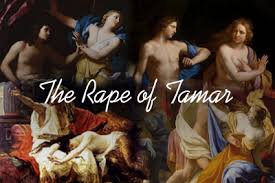
Genesis 38:24:Tamar’s pregnancy was discovered three months after conception, presumably because it was visible at that time. This was positive proof that she had been sexually active. Because she was a widow, without a husband, she was assumed to be a prostitute. Her father-in-law Judah ordered that she be burned alive for her crime. If Tamar’s twin fetuses had been considered to be human beings, one would have expected her execution would have been delayed until after their birth. There was no condemnation on Judah for deciding to take this action. (Judah later changed his mind when he found out that he was the male responsible for Tamar’s pregnancy.) 
If the fetuses that she was carrying are not to be regarded as living human beings at the end of her first trimester of pregnancy, then causing their death would not be a great moral concern.
However, if the twin fetuses are to be considered as human persons, then it seems strange that they would be considered of such little value as to allow them to be killed for the alleged sin of the woman carrying them. In this case, this passage may be expressing a theme that runs through the Bible from Genesis to Revelation: that it is acceptable to kill or otherwise punish innocent person or persons for the sins or crimes of others — the pregnant woman in this case.
An alternate interpretation is that innocent persons were often punished for the sins of one member of the family. See Joshua 7:21, Daniel 3:28-19, and Daniel 6:24). So it might be normal to give little concern to the fetuses.


Luke 1:15….[John] shall be filled with the Holy Ghost, even from his mother’s womb. Some translations of the Bible, refer to the time when John was a fetus. Others refer to when John was a newborn; the New International Version uses the phrase “even from birth.” The passage in Greek appears to be ambiguous; it might refer to a time during the third trimester when the fetus is viable. At any length, it refers to John’ special birth, not necessarily to infants today.
Luke 1:35: “…The Holy Ghost shall come upon thee, and the power of the Highest shall overshadow thee: therefore also that holy thing which shall be born of thee shall be called the Son of God.” In this passage, the angels refer to the fetus which Mary will carry as a “thing,” not a male person. The gender in the original Greek is neuter. Jesus is only referred to by the title “Son of God” after he is born, presumably after he becomes a person. This is consistent with the traditional Jewish belief that a fetus becomes a full human after it has half-emerged from the mother’s birth canal.
Luke 1:41…when Elizabeth heard the salutation of Mary, the babe leaped in her womb…. Elizabeth’s fetus was in an advanced stage of pregnancy. Verse 36 states that she was in her 6th month, at a time when the fetus is probably viable with today’s medical technology. The verse might be intended to imply that a 6th month (26 to 30th week) fetus has some degree of awareness of its environment, is capable of living independently, and should be considered as a “pre-born” human person worthy of protection. It says nothing about a first trimester fetus without a functioning brain, consciousness or nervous system. This passage might be used to argue against the morality of a third-trimester abortion. 
Matthew 26:24: “…but woe unto that man by whom the Son of man is betrayed! it had been good for that man if he had not been born.” This verse states that it would have been better for any person who betrayed Jesus if he had never been born. The verse might be interpreted as meaning that a terminated pregnancy might be better than a completed pregnancy, if the child’s life would be miserable.

Life begins and ends with breath

The Bible has a surprisingly straightforward definition of life, one outlined at length by Will McLeod on DailyKos back in March. From Genesis 2:7, where God literally breathes life into Adam in what can only be described as omnipotent CPR, to Isaiah 42:5, where God is referred to as the Creator who “gives breath to [the Earth’s] people,” the Bible is fairly consistent in defining things that are breathing as alive, and things that are not breathingas not-alive.

As feminist writer Joyce Arthur has pointed out, Jeremiah 1:4-5 is often cited to argue against this definition, as it states that “Before I formed you in the womb, I knew you.”

But the verse only refers to one person: Jeremiah. And even then, God is only referring to the knowledge that Jeremiah is destined for greatness, not a living and (ahem) breathing person.

Exodus 21:22-25: A fetus isn’t as alive as its mother

But let’s say for a moment that life begins some undetermined amount of time before the fetus takes its first breath. The Bible still credits the mother with being more-alive than the fetus she is carrying. As Exodus 21:22-25 reads:

If people are fighting and hit a pregnant woman and she gives birth prematurely or has a miscarriage but there is no serious injury, the offender must be fined whatever the woman’s husband demands and the court allows. But if there is serious injury, you are to take life for life, eye for eye, tooth for tooth, hand for hand, foot for foot, burn for burn, wound for wound, bruise for bruise.

Setting aside the suggestion that a beating-induced miscarriage doesn’t constitute “serious injury,” the logic is fairly straightforward: “Life for life” applies to a woman, but not to the fetus she’s carrying. In other words, the fetus is definitively placed in the ranks of not-alive.

Numbers 5:11-31: Abortion is preferable to bastardization

Numbers 5:11-31, which outlines the trial by ordeal that women must go through if their husband suspects that the baby she’s carrying may not be his. As the verses outline, if a husband thinks that his wife has been unfaithful he is to take her to the priest, who then performs a ritual that would make a shaman in an Indiana Jones movie do a double-take. The priest is to take holy water; mix it with dirt from the temple floor and the ink from a curse he has just written down; and make the woman drink the mixture. If she hasn’t committed adultery, nothing will happen; if she cheated, “her abdomen will swell and her womb will miscarry” — the pregnancy will literally be terminated on the spot.

Rahab and Tamar

Depending on whether or not you attribute the magic and mysticism behind the trial-by-ordeal to the intrinsic sin behind adultery, or to God’s own intervention, you’re left with one of two conclusions. Either God mandates abortion in cases of adultery or God is performing the abortion themselves. Whichever is the case, the teaching is clear: It’s better to abort a fetus conceived out of wedlock than to carry that fetus to term.

Ecclesiastes 6:1-6: Content and quality of life matter in conjunction with mere life

This is one of the more interesting philosophical questions surrounding whether it is acceptable to prevent potential life from becoming actual life. If bringing a new life into the world will be a net-negative in terms of humanity’s happiness and overall well being, is it acceptable to end the process by which that new life would begin?

Ecclesiastes 6:1-6:

 “I have seen another evil under the sun, and it weighs heavily on mankind: God gives some people wealth, possessions and honor, so that they lack nothing their hearts desire, but God does not grant them the ability to enjoy them, and strangers enjoy them instead. This is meaningless, a grievous evil. A man may have a hundred children and live many years; yet no matter how long he lives, if he cannot enjoy his prosperity and does not receive proper burial, I say that a stillborn child is better off than he. It comes without meaning, it departs in darkness, and in darkness its name is shrouded. Though it never saw the sun or knew anything, it has more rest than does that man— even if he lives a thousand years twice over but fails to enjoy his prosperity. Do not all go to the same place?”

Conflicting biblical beliefs indicate that moral issues are complex and not easily judged.

Posted in Morality | Leave a comment

What if Jesus Never Intended His Followers to Form a Church as we Know it Today?

Peter DeHaan 

I looked at where the Bible talks about the kingdom of God and where it talks about church. What I learned is shocking. Jesus teaches about the kingdom of God, not church.

These are New Testament Considerations

Both the church and the kingdom of God (along with the kingdom of Heaven) are New Testament concepts. None of these terms occur in the Old Testament. Since Jesus comes to fulfill the Law (Matthew 5:17), the kingdom of God must be one way he intends to do so.

Jesus Teaches about the Kingdom of God, not Church

Jesus talks much about the kingdom of God (Heaven) and little about the church: fifty-four times versus three. Clearly Jesus focuses his teaching on the kingdom of God. If the kingdom of God is so important to Jesus, it should be important to us as well.

A Change Occurs in Acts

A transition of emphasis happens in the book of Acts, with twenty-one mentions of church and only six mentions of the kingdom of God. Early on Jesus’s followers shift their focus from the kingdom of God to the church. This is logical because a church is a tangible result while the kingdom of God is a more ethereal concept. But just because this is a logical shift, that doesn’t make it right.

Jesus’s Followers Focus on Church

The rest of the New Testament (Romans through Revelation) emphasizes church over the kingdom of God: ninety times versus eight. Even though the early followers of Jesus favor the practice of church over the concept of the kingdom of God, the fact remains that their practice of church then is far different from ours today.

Today’s church should push aside her traditions and practices to replace them with what Jesus teaches about the kingdom of God. It will change everything.

(Here’s the background:

The word church occurs 114 times in the Bible, all in the New Testament. Of the four accounts of Jesus, church only occurs in Matthew and then just three times. Acts, the book about the early church, mentions church twenty-one times. The word church occurs in the majority of the rest of the New Testament books (fifteen of them).

Instead of church, Jesus talks about the kingdom of God. The phrase, kingdom of God, occurs sixty-eight times in the Bible, again, all in the New Testament. The majority of occurrences are in the four biographies of Jesus, accounting for fifty-four of its sixty-eight appearances. Acts mentions the kingdom of God six times, with only eight occurrences popping up in the rest of the New Testament.

Matthew generally writes using the kingdom of Heaven instead of the kingdom of God. He uses kingdom of Heaven thirty-one times and is the only writer in the Bible to use this phrase. By comparing parallel passages in Matthew, Mark, and Luke, we see the same account with the only difference being that Matthew writes kingdom of Heaven whereas Mark and Luke use kingdom of God. Clearly Matthew, the only biblical writer to use kingdom of Heaven, equates it to kingdom of God. Additionally Matthew uses the kingdom of God five times.)

Peter DeHaan writes about biblical spirituality, often with a postmodern slant. He seeks a fresh approach to faith and following God through the lens of scripture, without the baggage of made-up traditions and meaningless practices. Read more in his books, blog, and weekly email updates.

Posted in Ecclesiology | Leave a comment

The Significance of Christ- Grace

In making the point about what he calls the “paradoxical Christian secret,” Baillie is seeking to describe the subtle differ­ence between the kind of goodness that is a response to the spirit of Christ and the kind that is mere obedience to moral law. In the former, the person loves because he has been loved-he has forgotten himself in his concern for the other. He therefore is not thinking about himself doing a good deed, earning moral points, etc. This emphasis in Christian thought derives from the idea that the new life is a gift of God which is either received or rejected. It is not something the person fashions for himself out of moral effort or earns after some self-improvement.

  1. M. Baillie

We may begin with the familiar words of St. Paul: “By the grace of God I am what I am: and his grace which was be­stowed upon me was not found vain; but I labored more abun­dantly than they all: yet not I, but the grace of God which was with me.”

(1 Corinthians 15:10)

Thus the paradoxical Christian secret, while it transcends the moralistic attitude by ascribing all to God, does not make us morally irresponsible. That is part of the paradox. No one knows better than the Christian that he is free to choose and that in a sense everything depends upon his choice…. My actions are my very own, expressions of my own will, my own choice. No one else can choose for me or relieve me of the responsibility. When I make the wrong choice, I am entirely responsible, and my conscience condemns me. And yet (here is the paradox) when I make the right choice, my conscience does not applaud or congratulate me. I do not feel meritorious or glow with self­-esteem-if and in so far as I am a Christian. Instead of that I say: “Not I, but the grace of God.” Thus while there is a human side to every good action, so that it is genuinely the free choice of a person with a will, yet somehow the Christian feels that the other side of it, the divine side, is logically prior…. It is not as if we could divide the honors between God and ourselves, God doing His part, and we doing ours. It cannot even be adequately expressed in terms of divine initiative and human co-operation. It is false to this paradox to think of the area of God’s action and the area of our action being delimited, each by the other, and distinguished from each other by a boundary, so that the more of God’s grace there is in an action, the less is it my own per­sonal action…. We are not marionettes, but responsible per­sons, and never more truly and fully personal in our actions than in those moments when we are most dependent on God and He lives and acts in us. And yet the divine side is somehow prior to the human.

What I wish to suggest is that this paradox of grace points the way more clearly and makes a better approach than anything else in our experience to the mystery of the Incarnation itself; that this paradox in its fragmentary form in our own Christian lives is a reflection of that perfect union of God and man in the Incarnation on which our whole Christian life depends, and may therefore be our best clue to the understanding of it. In the New Testament we see the man in whom God was incarnate surpass­ing all other men in refusing to claim anything for Himself inde­pendently and ascribing all the goodness to God. We see Him also desiring to take up other men into His own close union with God, that they might be as He was. And if these men, entering in some small measure through Him into that union, experience the paradox of grace for themselves in fragmentary ways, and are constrained to say, “It was not I but God,” may not this be a clue to the understanding of that perfect life in which the para­dox is complete and absolute, that life of Jesus which, being the perfection of humanity, is also, and even in a deeper and prior sense, the very life of God Himself? If the paradox is a reality in our poor imperfect lives at all, so far as there is any good in them, does not the same or a similar paradox, taken at the perfect and absolute pitch, appear as the mystery of the Incarnation?

. . . This is the Creator-God who made us to be free personali­ties, and we know that we are most free and personal when He is most in possession of us. This is the God of the moral order who calls us every moment to exercise our full and responsible choice; but He also comes to dwell in us in such a way that we are raised altogether above the moral order into the liberty of the sons of God. That is what Christians mean by “God.” It is highly para­doxical, but it is bound up with the whole message of Christi­anity and the whole structure of the Christian life; and it follows inevitably if we take seriously the fundamental paradox: “Not I, but the grace of God.” It is God’s very nature to give Himself in that way: to dwell in man in such a manner that man, by his own will choosing to do God’s will (and in a sense it must depend on man’s own choice) nevertheless is constrained to confess that it was “all of God.”

  1. M. Baillie, God Was in Christ (New York, 1948), pp.114, 116-118,121-122.
Posted in Morality | Leave a comment

Sir John Polkinghorne on Science and Theology

BOB ABERNETHY: Now, Perspectives today on one man’s view of the continuing struggle between religion and science. Sir John Polkinghorne is both a world-class physicist and an Anglican priest who says science can explain only part of what’s real. Chris Roberts has our profile.

CHRIS ROBERTS: In a physics lab, a high-powered laser beam slices through a tank of water. For at least 400 years, the observations and tests of science, like a laser beam in turbulent water, have often churned through the teachings of religion. But now an eminent thinker on science and religion is casting new light on the controversy. He recently spoke at New York’s Cornell University.

Sir JOHN POLKINGHORNE (Scientist and Theologian): Science and theology have enough in common to find a mutual conversation and indeed a mutual friendship between them.

Go to

Sir John Polkinghorne on Science and Theology

to continue this interview.

Posted in Theology | Leave a comment

The God Who Beckons

Article Details

Recent discoveries in science have given us a new picture of the divine creator  There was a time when asking a question about the purpose of life was simpler, because the answer never changed. Whatever existed and happened, we knew, was the eternal will and calculated design of God. Then Charles came along. The unfolding of Charles Darwin’s theory of evolution and the launch of Fr. Georges Lemaître’s big bang theory changed everything.  By Joan Chittister 

Katie was a second-grader in one of our schools. One Friday at art class as the teacher roamed the aisles checking progress, she stopped at Katie’s desk and asked, “Well, Katie, what are you drawing?”
“I am drawing a picture of God,” Katie said proudly.
“Katie,” the teacher answered, “you can’t draw a picture of God. Nobody knows what God looks like.”
Katie said, “They will when I’m finished.”
We are all invited now to draw a new picture of God.
Picasso said: “God is just another artist. He made a giraffe, an elephant and a cat. He has no style. He just keeps trying new things.” And Simone Weil wrote, “It is only the impossible that is possible for God. He has given over the possible to the mechanics of matter and the autonomy of his creatures.”
What happens when classical spirituality meets modern science? Which of them is “right”? Are the two reconcilable? Or are they doomed to be eternal opposites?
There was a time when asking a question about the purpose of life was simpler than it is now because the answer never changed. Whatever existed and happened, we knew, was the eternal will and calculated design of the God who had made things. Our one purpose in life was to keep a set of basically intractable but ultimately fundamental rules until we had managed to negotiate this world well enough to escape it to a better one.
The process was clear. The rules were unequivocal. Life was a game played to achieve spiritual perfection, despite the fact that we came to realize as life went on that perfection essentially and continually eluded us. Worse, “God’s will for us” was never totally apparent but we knew that it had something to do with ferreting out and being faithful to an eternal plan fully known only by God but incumbent upon us.
We learned that God had a particular function or role for each of us: male and female, clergy and lay, slave and free, ruler and ruled. In that schema the purpose of life was certain, however obscure the project itself. It was, in other words, a game of cosmic dice. Some people won; some people didn’t. And God was in charge of it all.
Until Charles came along.
The unfolding of Charles Darwin’s theory of evolution and the launch, ironically, of the priest Georges Lemaître’s big bang theory — you can imagine how popular that made him in the church — changed
everything. Evolution and the big bang theory may have clarified the questions of science about the origin and end of life but they continue to this day to unsettle what until now had become relatively standard, unarguable theological conclusions concerning the ways of God with the world.
Two issues in particular challenge the commonplaces of religion and spiritual identity.
The first concerns the traditional definition of creation. Instead of the until now uncontested notion that every creature on earth is the unique and purposeful creation of God, it has begun to dawn, in the light of Darwin’s theory of evolution, that life may well be simply an accident of organic chemistry.
After billions of years, of multiple mistakes, a cycle of chemical configurations and a series of hit-and- miss successes, life as we know it, science tells us, simply emerged. With no sense of uniqueness, no evidence of completeness, and no supernatural intervention.
As a result, life, some argue, is a self-generating fortuity, spawned by nothing, for the sake of nothing, with nowhere to go.
With an explanation like that, the whole notion of life’s meaningfulness simply evaporates into the bizarrely unique chemistry that sustains it.
Thrown into orbit by a primordial blast — who knows why — billions of years ago, we are trapped here simply waiting for the fire in the blast to die out and the ice that follows it all to go to dust.
A subtler God
End of story, some say. In this model God is passé; life is purposeless. But is the tale of evolution necessarily all that bleak, all that spiritually arid, all that purposeless?
The answer, I think, does not lie in damning, rejecting or quibbling with the data of science. The answer depends on humanity’s rethinking its definition of God. It depends on our ability to imagine a greater sense of self. It depends on our understanding of the ecology of life. It depends on what the metaphor of evolution itself might have to say about both the nature of God and our own possible place in an evolving universe.
Of all the statements Einstein ever made, beyond relativity, beyond the bend in space and time, it is what he said about God that may, in the end, be seen as his most profound insight of them all.
“God,” said Einstein, “is subtle but not malicious.”
Bubble Nebula NGC 7635Well, perhaps … but such subtlety and goodwill were hardly visible to the human eye, hardly arguable to those who were suffering the evil they were told was meant simply to test their fidelity or to try their character.
Such subtlety, in fact, is barely sustainable without the eye of blind faith in the light of the injustices and struggles of the real world around us.
For centuries, for instance, the struggle to define the origin of evil and the nature of God has plagued the religious community, has challenged spirituality to the limits. Few questions have done more than this one to strain the fabric of churches or the bonds between thinkers and believers, between philosophers and theologians.
In our time, with the addition of the relatively newfound scientific problem of the nature of creation itself, the very existence of religion could well seem to be in danger and a sense of spiritual purpose a thing of the past.
If life, as science says, is self-creating, what can possibly be the cosmic or overarching purpose of life? What, in fact, can be the purpose of God?
It all depends, of course, on who we say God is. A wag said: First God created humans; then humans created God. And we did. To the point that nothing we know about science now equates with what we have told ourselves about God.
As a result, science confronts the definition of God as we have framed it in the past but, in the process, ironically gives us the opportunity now to see the multiple dimensions of God that we missed.
And this great crossover point, this new Galileo moment in history, gives us a sense of purpose in life that is beyond the sanctification of the self. Indeed, this is the moment after which everything religion has said about the nature of God must somehow shift.
The God of creation, the religious world determined, was all-knowing, all-powerful, all-present and all- holy. The problem lay in the fact that a God of these proportions failed, it seemed, to exercise such power when it came to the creation this very God had created.
This God did not save the world from evil, did not exercise blatant power in behalf of the good, did not save the righteous from the unrighteous, did not act in behalf of the oppressed. This was a God whose merit theology, whose rule-driven scorekeeping, trumped care, compassion and love.
The faithful, we were taught, got the God they earned, or, conversely, lost the God they didn’t, if they were unable to figure out what that God really wanted in every situation and how to pass every spiritual double-bind test.
Instead, they could, at best, only hope for eternal life and everlasting peace somewhere else. This life was out of their hands. This world was a mysterious jumble of good and evil meant to tempt and try them. This was not a subtle God; this was a God whose “will” too often looked more like malice than it did like mercy. The ways of this God with creation were straightforward and manifest. The creator God was patriarch, lawgiver and avenging judge.
Not only was this God not a “subtle” God but how could we say with certainty that this God was not a malevolent one, except that our hearts tell us that God, to be God, must be more than that.
As a consequence of theology like that, we enthroned maleness. We exalted a “rationality” that was far
too often deeply irrational. We created the distant and unemotional God of the Greek philosophers who affects our life at every stage and every moment since. This creator God exercised power over everything, we said. But then we got confused trying to explain that God’s failure to use that power in order to save us from what endangers us.
We talked about “free will” but got tangled up again in the implications of what it means to be the weanlings of an all-knowing God. If God really knew everything before it happened, how could we possibly have free will?
We chafed under the burden of the “perfectionism” that the will of an all-perfect God must, of necessity, require of us, but of which, it was clear, we were patently incapable. The inferences of this kind of God for our own well-being were heavy indeed.
But then came Darwin and evolution and an entirely new way of seeing both creation and the world. In this world, every act of creation is not the unique act of an eternal God.
Instead, the God of creation becomes the God of ongoing creation, of life intent on its own development, and of life involved in contributing to its own emerging form.
Polar-Ring Galaxy NGC 4650AFrom this perspective, creation, life itself, is a work in process. It grows from one stage to another. It is immersed in both possibility and mistakes. It is a creature of imagination on the way to the unimaginable. The God of grand but hidden designs becomes the God of evolution, of the working out of creation as we go. Suddenly free will, the choices we make as we labor at the project of life, becomes important. Decision-making becomes universally significant, and selection of our actions determines the shape of an ongoing evolving world.
The humble God
A self-creating universe becomes co-creator with the humble God who shares power and waits for the best from us and provides for what we need to make it happen. We become participants in the process of life and the development of the world that is not so much planned as it is enabled. As nature grows, experiments, unfolds, selects and adapts, so then must we. Growth, not perfection, becomes the purpose of life. Ongoing creation, not predestined fate, becomes the purpose of life.
The very process of human growth, not human puppetry in the hands of a disinterested and demanding God, becomes the purpose of life. And God becomes the God of a universe on its way to growing into glory, of becoming one with its creator. Life ceases to be a program of expectations tied up in a black …
box, the purpose of which is to tease us into unlocking and unraveling the mystery of our lives before it gets to be too late to achieve it.
In an evolving world, then, God becomes “becoming.” God is the one who stands by as we grow from one self to another, from one level of insight to another, from one age and awareness to another. God, we come to understand, is not the God of fixed determinations now. The past is no longer a template of forever. God becomes instead the God of the future. God, we come to see in the model that is evolutionary, is promise and possibility and forever emerging life.
The spiritual implications of a creation that goes on creating are major.
We are meant to create with the creator. We are here to discover the rest of ourselves in an equally evolving cosmos. We are not about perfection. We are about always selecting the better, about entering into the transformation of the world as it experiments with life, chooses for life, sees mistakes not as failure but as one more learning on the ladder of spiritual success.
In this world, the God of evolution becomes God the mother as well as God the father. God the mother understands pain. She bears us and then lets us grow from error to solution, from failure to success. She loves us for trying. She not only sets the standard, she helps us over the bar.
She is the rest of the image of the biblical God that Abrahamic religions have largely ignored to the peril of true spiritual development but that the spirit knows and seeks forever. She, the biblical God, “Cries out as a woman in labor” (Isaiah 42:14). She is the one whom the psalmist sees as “a nursing woman” (Psalm 131: 1-2), who in Hosea (11:3-4) is a cuddling mother who takes Israel in her arms, and who, in Proverbs as wisdom, “is there with God in the beginning” (8:22-31).
In a world in evolution is there purpose in the universe? The answer must certainly be: Never more so than now. Evolution is, in fact, a great spiritual teacher. We learn from the fossils of the ages that development is most often a slow and uncertain process, a precarious and breakneck experience that demands both time and trust in the future that is God, and in the God of the future. Evolution teaches us that movement from one stage of life to another is often both cumbersome and painful but that the pain is prelude to a better self.
We learn that failure is a necessary part of life, not its misdoing. It is simply a holy invitation to become more than we are at present. Time is grace and trying is virtue. Struggle is a sign of new life, not a condemnation of this one.
Evolution shows us that the God of becoming is a beckoning God who goes before us to invite us on, to sustain us on the way, rather than a judging God who measures us by a past we did not shape.
Now human beings can begin to revel in what is meant by growing to full stature as a responsible and participative spiritual adult whose work on the planet really, really matters. Life, suddenly, is more a blessing both to the universe and to the self than it is simply a test of a person’s moral limits. To be alive, to be a person in the process of becoming, it becomes clear, is a blessing, not a bane. We are, alone and together, significant actors in the nature of life and the strengthening of the fibers of humankind.
Evolution gives us a God big enough to believe in.
Benedictine Sr. Joan Chittister is a best-selling author and international lecturer on topics of justice,

Posted in Theology | Leave a comment

Divine Providence and Human Freedom

During the general audience in St Peter’s Square on 21 May, 1986, the Holy Father, John Paul II continued his catechesis on Divine Providence. The conference was based on the biblical text, Sirach 15: 14-15, 18-20, and is the thirteenth in the present series.
1. In our journey into the depths of the mystery of God as Providence, we frequently come up against the question: if God is present and operating in everything, how can man be free? And above all, what meaning and task does his freedom have? How are we to understand in the light of Divine Providence that evil fruit of sin which derives from an abuse of freedom?
Let us take up again the solemn statement of Vatican I: “All that God created, he conserves and directs by his Providence ‘reaching from end to end mightily and governing all things well’ (cf. Wis 8:1). ‘All lies bare and exposed to his eyes’ (cf. Heb 4:13), even what will take place through the free initiative of creatures” (DB, 3003).
The mystery of Divine Providence is deeply inscribed in the whole work of creation. As the expression of God’s eternal wisdom, the plan of Providence precedes the work of creation. As the expression of his eternal power, it presides over it and puts it into effect; and in a certain sense it can be said that Providence is realized in it. It is a transcendent Providence, but at the same time immanent in things, in all things. According to the text of the Council that we have read, this is valid especially in the order of creatures endowed with intelligence and free will.
2. While comprising “mightily and disposing well” the whole of creation, Providence embraces in a particular way creatures made in the image and likeness of God. They enjoy, through the freedom granted to them by the Creator, “the autonomy of created beings”, in the sense understood by the Second Vatican Council (cf. GS, 36). Within the sphere of these creatures should be included created beings of a purely spiritual nature about whom we shall speak later. They constitute the invisible world. In the visible world Divine Providence’s object of particular attention is man, “who”, according to the teaching of Vatican II, “is the only creature on earth that God has wanted for its own sake” (GS, 24), and it is precisely for this reason that “man can fully discover his true self only in a sincere giving of himself” (cf. GS, 24).
God’s loving Wisdom
3. The fact that the visible world is crowned by the creation of man, opens up before us completely new perspectives on the mystery of Divine Providence. That is indicated by the dogmatic statement of the First Vatican Council when it emphasizes that to the eyes of divine wisdom and knowledge all lies “bare” (“open”), in a certain sense naked— even what the rational creature does by virtue of his freedom: that which is the result of a conscious choice, and of a free decision of the human person. Even in regard to this sphere Divine Providence preserves its superior creative and regulating causality. It is the transcendent superiority of the Wisdom which loves, and through love it acts mightily and
gently, and is therefore a Providence which solicitously and paternally guides, sustains and leads to its end his own creature, so richly endowed, while respecting its freedom.
4. In this meeting point of God’s creative eternal plan with man’s freedom, there indubitably looms up a mystery as inscrutable as it is adorable. The mystery consists in the intimate relation, first of all ontological and then psychological, between the divine action and human self-determination. We know that this freedom of decision pertains to the natural dynamism of the rational creature. We also know by experience the fact of human freedom, authentic even though wounded and weak. As regards its relation to divine causality, it is opportune to recall St Thomas Aquinas’s emphasis on the concept of Providence as the expression of divine Wisdom which orders all things to their proper end: ratio ordinis rerum in finem, “the rational ordering of things to their end” (cf. Summa Th., I, 22, 1). All that God creates receives this finality, and therefore becomes the object of Divine Providence (cf. ibid., I, 22,2). In man— created in the image of God—the whole visible creation should draw near to God, finding again the way of its definitive fulfillment. This thought already expressed, among others, by St Irenaeus (Adv. Haereses, 4, 38;1105-1109), is echoed by the teaching of Vatican Council II on the development of the world by the work of mankind (cf. GS, 7). True development—that is progress—which man is called upon to carry out in the world, should have a character, not merely “technological”, but especially “ethical”, in order to bring to fulfillment in the created world the kingdom of God (cf. GS, 35, 43, 57, 62).
5. Man, created in the image and likeness of God, is the sole visible creature that the creator has “willed for its own sake” (GS, 24). In the world subject to God’s transcendent wisdom and power, man, though having his finality in God, is also a being which is an end in itself. As a person he possesses his own finality (auto-teleology), by virtue of which he tends to self-realization. Enriched with a gift which is also a duty, man is wrapped up in the mystery of Divine Providence. We read in the Book of Sirach:
“The Lord created man out of earth……he granted them authority over the things upon the earth…He forms men’s tongues and eyes and ears, and imparts to them  an understanding heart.With wisdom and knowledge he fills them; good and evil he shows them.He looks with favor upon their hearts, and shows them his glorious works..  He has set before them knowledge, a law of life as their inheritance…” (Sir 17:1-2, 5-7, 9).
6. Endowed with such an “existential” equipment, we might say, man sets out on his journey in the world. He begins to write his own history. Divine Providence accompanies him throughout his journey. Again we read in the Book of Sirach:
“Their ways are ever known to him, they cannot be hidden from his eyes…All their actions are clear as the sun to him, his eyes are ever upon their ways” (Sir 17:13, 15).
The Psalmist gives to this same truth a touching expression: “If I take the wings of the dawn, if I settle at the farthest limits of the sea, even there your hand shall guide me,
and your right hand hold me fast” (Ps 138 [139]:9-10)….you know me full well; nor was my frame unknown to you… (Ps 138 [139]:14-15).
7. Divine Providence, then, makes itself present in the history of man, in the history of his thought and freedom, in the history of hearts and consciences. In man and with man the action of Providence acquires an “historical” dimension, in the sense that it follows the rhythm and adapts itself to the laws of development of human nature, while remaining unchanged and unchangeable in the sovereign transcendence of its subsisting being. Providence is an eternal Presence in the history of mankind: of individuals and communities. The history of nations and of the whole human race unfolds beneath the “eye” of God and under his almighty action. If all that is created is “cared for” and governed by Providence, God’s authority, full of paternal solicitude, implies, in regard to rational and free beings, full respect for freedom, which in the created world is the expression of the image and likeness to the Divine Being itself, to Divine Freedom itself.
8. Respect for created freedom is so essential that God in his Providence even permits man’s sin (and that of the angel). The rational creature, pre-eminent among all but always limited and imperfect, can make evil use of his freedom, he can use it against God, his Creator. It is an agonizing subject for the human mind, and the Book of Sirach has reflected on it in words of great depth:
“When God, in the beginning, created man, he made him subject to his own free choice.  If you choose you can keep the commandments; it is loyalty to do his will. There are set before you fire and water; to whichever you choose, stretch forth your hand. Before man are life and death, whichever he chooses shall be given him. Immense is the wisdom of the Lord; he is mighty in power, and all-seeing. The eyes of God see all he has made;  he understands man’s every deed. No man does he command to sin, to none does he give strength for lies. (Sir 15:14-20).
9. “Who can detect failings?” the Psalmist asks (cf. Ps 18 [19]:13). Yet even on this unheard of rejection by man (through sin) Divine Providence sheds its light so that we may learn not to commit it.
In the world in which man was created as a rational and free being, sin was not only possible, but it has been shown as an actual fact “from the very beginning”. Sin is radical opposition to God, it is decidedly and absolutely not willed by God. However, he has permitted it by creating free beings, by creating man. He has permitted sin which is the consequence of the abuse of created freedom. From this fact, known from Revelation and experienced in its consequences, we can deduce that from the viewpoint of God’s transcendent Wisdom, in the perspective of the finality of the entire creation, it was more important that there should be freedom in the created world, even with the risk of its abuse, rather than to deprive the world of freedom by the radical exclusion of the possibility of sin.
By God’s Providence, however, if on the one hand he has permitted sin, on the other, with the loving solicitude of a Father, he has foreseen from eternity the way of reparation, of
redemption, of justification and of salvation through Love. Freedom in fact is ordained to love; without freedom there cannot be love. In the conflict between good and evil, between sin and redemption, love has the last word.
L’Osservatore Romano May 26, 1986  Reprinted with permission.

Posted in Theology | Leave a comment

God and Evolution


     Avery Cardinal Dulles        October 2007

During the second half of the nineteenth century, it became common to speak of a war between science and religion. But over the course of the twentieth century, that hostility gradually subsided. Following in the footsteps of the Second Vatican Council, John Paul II at the beginning of his pontificate established a commission to review and correct the condemnation of Galileo at his trial of 1633. In 1983 he held a conference celebrating the 350th anniversary of the publication of Galileo’s Dialogues Concerning Two New Sciences, at which he remarked that the experience of the Galileo case had led the Church “to a more mature attitude and a more accurate grasp of the authority proper to her,” enabling her better to distinguish between “essentials of the faith” and the “scientific systems of a given age.”


From September 21 to 26, 1987, the pope sponsored a week of study on science and religion at Castel Gandolfo. On June 1, 1988, reflecting on the results of his conference, he sent a positive and encouraging letter to the director of the Vatican Observatory, steering a middle course between a separation and a fusion of the disciplines. He recommended a program of dialogue and interaction, in which science and religion would seek neither to supplant each other nor to ignore each other. They should search together for a more thorough understanding of one another’s competencies and limitations, and they should look especially for common ground. Science should not try to become religion, nor should religion seek to take the place of science. Science can purify religion from error and superstition, while religion purifies science from idolatry and false absolutes. Each discipline should therefore retain its integrity and yet be open to the insights and discoveries of the other.
In a widely noticed message on evolution to the Pontifical Academy of Sciences, sent on October 22, 1996, John Paul II noted that, while there are several theories of evolution, the fact of the evolution of the human body from lower forms of life is “more than a hypothesis.” But human life, he insisted, was separated from all that is less than human by an “ontological difference.” The spiritual soul, said the pope, does not simply emerge from the forces of living matter nor is it a mere epiphenomenon of matter. Faith enables us to affirm that the human soul is immediately created by God.
The pope was interpreted in some circles as having accepted the neo-Darwinian view that evolution is sufficiently explained by random mutations and natural selection (or “survival of the fittest”) without any kind of governing purpose or finality. Seeking to offset this misreading, Christoph Cardinal Schönborn, the archbishop of Vienna, published on July 7, 2005, an op-ed in the New York Times, in which he quoted a series of pronouncements of John Paul II to the contrary. For example, the pope declared at a General Audience of July 19, 1985: “The evolution of human beings, of which science seeks to determine the stages and discern the mechanism, presents an internal finality which arouses admiration. This finality, which directs beings in a direction for which they are not responsible, obliges one to suppose a Mind which is its inventor, its creator.” In this connection, the pope said that to ascribe human evolution to sheer chance would be an abdication of human intelligence.
Cardinal Schönborn was also able to cite Pope Benedict XVI, who stated in his inauguration Mass as pope on April 24, 2005: “We are not some casual and meaningless product of evolution. Each of us is the result of a thought of God. Each of us is willed, each of us is loved, each of us is necessary.”
Cardinal Schönborn’s article was interpreted by many readers as a rejection of evolution. Some letters to the editor accused him of favoring a retrograde form of creationism and of contradicting John Paul II. They seemed unable to grasp the fact that he was speaking the language of classical philosophy and was not opting for any particular scientific position. His critique was directed against those neo-Darwinists who pronounced on philosophical and theological questions by the methods of natural science.
Several authorities on these questions, such as Kenneth R. Miller and Stephen M. Barr, in their replies to Schönborn, insisted that one could be a neo-Darwinist in science and an orthodox Christian believer. Distinguishing different levels of knowledge, they contended that what is random from a scientific point of view is included in God’s eternal plan. God, so to speak, rolls the dice but is able by his comprehensive knowledge to foresee the result from all eternity.
This combination of Darwinism in science and theism in theology may be sustainable, but it is not the position Schönborn intended to attack. As he made clear in a subsequent article in First Things (January 2006), he was taking exception only to those neo-­Darwinists—and they are many—who maintain that no valid investigation of nature could be conducted except in the reductive mode of mechanism, which seeks to explain everything in terms of quantity, matter, and motion, excluding specific differences and purpose in nature. He quoted one such neo-Darwinist as stating: “Modern science directly implies that the world is organized strictly in accordance with deterministic principles or chance. There are no purposive principles whatsoever in nature. There are no gods and no designing forces rationally detectable.”
Cardinal Schönborn shrewdly observes that positivistic scientists begin by methodically excluding formal and final causes. Having then described natural processes in terms of merely efficient and material causality, they turn around and reject every other kind of explanation. They simply disallow the questions about why anything (including human life) exists, how we differ in nature from irrational animals, and how we ought to conduct our lives.
During the past few years, there has been a new burst of atheistic literature that claims the authority of science, and especially Darwinist theories of evolution, to demonstrate that it is irrational to believe in God. The titles of some of these books are revealing: The End of Faith by Sam Harris, Breaking the Spell: Religion as a Natural Phenomenon by Daniel Dennett, The God Delusion by Richard Dawkins, and God: The Failed Hypothesis by Victor J. Stenger. The new atheists are writing with the enthusiasm of evangelists propagating the gospel of atheism and irreligion.
These writers generally agree in holding that evidence, understood in the scientific sense, is the only valid ground for belief. Science performs objective observations by eye and by instrument; it builds models or hypotheses to account for the observed phenomena. It then tests the hypotheses by deducing consequences and seeing whether they can be verified or falsified by experiment. All worldly phenomena are presumed to be explicable by reference to inner-­worldly bodies and forces. Unless God were a verifiable hypothesis tested by scientific method, they hold, there would be no ground for religious belief.
Richard Dawkins, a leading spokesman for this new antireligion, may be taken as representative of the class. The proofs for the existence of God, he believes, are all invalid, since among other defects they leave unanswered the question “Who made God?” “Faith,” he writes, “is the great cop-out, the great excuse to evade the need to think and evaluate evidence. . . . Faith, being belief that isn’t based on evidence, is the principal vice in any religion.” Carried away by his own ideology, he speaks of “the fatuousness of the religiously indoctrinated mind.” He makes the boast that, in the quest to explain the nature of human life and of the universe in which we find ourselves, religion “is now completely superseded by science.”
Dawkins’ understanding of religious faith as an irrational commitment strikes the Catholic as strange. The First Vatican Council condemned fideism, the doctrine that faith is irrational. It insisted that faith is and must be in harmony with reason. John Paul II developed the same idea in his encyclical on Faith and Reason, and Benedict XVI in his Regensburg academic lecture of September 12, 2006, insisted on the necessary harmony between faith and reason. In that context, he called for a recovery of reason in its full range, offsetting the tendency of modern science to limit reason to the empirically verifiable.
Catholics who are expert in the biological sciences take several different positions on evolution. As I have indicated, one group, while explaining evolution in terms of random mutations and survival of the fittest, accepts the Darwinist account as accurate on the scientific level but rejects Darwinism as a philosophical system. This first group holds that God, eternally foreseeing all the products of evolution, uses the natural process of evolution to work out his creative plan. Following Fred Hoyle, some members of this group speak of the “anthropic principle,” meaning that the universe was “fine-tuned” from the first moment of creation to allow the emergence of human life.
A recent example of this point of view may be found in Francis S. Collins’ 2006 book, The Language of God. Collins, a world-renowned expert on genetics and microbiology, was reared without any religious belief and became a Christian after finishing his education in chemistry, biology, and medicine. His professional knowledge in these fields convinced him that the beauty and symmetry of human genes and genomes strongly testifies in favor of a wise and loving Creator. But God, he believes, does not need to intervene in the process of bodily evolution. Collins holds for a theory of theistic evolutionism that he designates as the BioLogos position.
Although Collins is not a Catholic, he approvingly refers to the views of John Paul II on evolution in the 1996 message to the Pontifical Academy of Sciences. He builds on the work of the Anglican priest Arthur Peacock, who has written a book with the title Evolution: The Disguised Friend of Faith. He quotes with satisfaction the words of President Bill Clinton, who declared at a White House celebration of the Human Genome Project in June 2000: “Today we are learning the language in which God created life. We are gaining ever more awe for the complexity, the beauty, and the wonder of God’s most divine and sacred gift.”
Theistic evolutionism, like classical Darwinism, refrains from asserting any divine intervention in the process of evolution. It concedes that the emergence of living bodies, including the human, can be accounted for on the empirical level by random mutations and survival of the fittest.
But theistic evolutionism rejects the atheistic conclusions of Dawkins and his cohorts. The physical sciences, it maintains, are not the sole acceptable source of truth and certitude. Science has a real though limited competence. It can tell us a great deal about the processes that can be observed or controlled by the senses and by instruments, but it has no way of answering deeper questions involving reality as a whole. Far from being able to replace religion, it cannot begin to tell us what brought the world into existence, nor why the world exists, nor what our ultimate destiny is, nor how we should act in order to be the kind of persons we ought to be.
Viewed as a scientific system, Darwinism has some attractive features. Its great advantage is its simplicity. Ignoring the specific differences between different types of being and the purposes for which they act, Darwinism of this type reduces the whole process of evolution to matter and motion. On its own level it produces plausible explanations that seem to satisfy many practicing scientists.
Notwithstanding these advantages, Darwinism has not entirely triumphed, even in the scientific field. An important school of scientists supports a theory known as Intelligent Design. Michael Behe, a professor at Lehigh University, contends that certain organs of living beings are “irreducibly complex.” Their formation could not take place by small random mutations, because something that had only some but not all the features of the new organ would have no reason for existence and no advantage for survival. It would make no sense, for example, for the pupil of the eye to evolve if there were no retina to accompany it, and it would be nonsensical for there to be a retina with no pupil. As a showcase example of a complex organ all of whose parts are interdependent, Behe proposes the bacterial flagellum, a marvelous swimming device used by some bacteria.
At this point we get into a technical dispute among microbiologists that I will not attempt to adjudicate. In favor of Behe and his school, we may say that the possibility of sudden major changes effected by a higher intelligence should not be antecedently ruled out. But we may take it as a sound principle that God does not intervene in the created order without necessity. If the production of organs such as the bacterial flagellum can be explained by the gradual accumulation of minor random variations, the Darwinist explanation should be preferred. As a matter of policy, it is imprudent to build one’s case for faith on what science has not yet explained, because tomorrow it may be able to explain what it cannot explain today. History teaches us that the “God of the gaps” often proves to be an illusion.
Darwinism is criticized by yet a third school of critics, one which includes philosophers such as Michael Polanyi, who build on the work of Henri Bergson and Teilhard de Chardin. Philosophers of this orientation, notwithstanding their mutual differences, agree that biological organisms cannot be understood by the laws of mechanics alone. The laws of biology, without in any way contradicting those of physics and chemistry, are more complex. The behavior of living organisms cannot be explained without taking into account their striving for life and growth. Plants, by reaching out for sunlight and nourishment, betray an intrinsic aspiration to live and grow. This internal finality makes them capable of success and failure in ways that stones and minerals are not. Because of the ontological gap that separates the living from the nonliving, the emergence of life cannot be accounted for on the basis of purely mechanical principles.
In tune with this school of thought, the English mathematical physicist John Polkinghorne holds that Darwinism is incapable of explaining why multicellular plants and animals arise when single cellular organisms seem to cope with the environment quite successfully. There must be in the universe a thrust toward higher and more-complex forms. The Georgetown professor John F. Haught, in a recent defense of the same point of view, notes that natural science achieves exact results by restricting itself to measurable phenomena, ignoring deeper questions about meaning and purpose. By its method, it filters out subjectivity, feeling, and striving, all of which are essential to a full theory of cognition. Materialistic Darwinism is incapable of explaining why the universe gives rise to subjectivity, feeling, and striving.
The Thomist philosopher Etienne Gilson vigorously contended in his 1971 book From Aristotle to Darwin and Back Again that Francis Bacon and others perpetrated a philosophical error when they eliminated two of Aristotle’s four causes from the purview of science. They sought to explain everything in mechanistic terms, referring only to material and efficient causes and discarding formal and final causality.
Without the form, or the formal cause, it would be impossible to account for the unity and specific identity of any substance. In the human composite the form is the spiritual soul, which makes the organism a single entity and gives it its human character. Once the form is lost, the material elements decompose, and the body ceases to be human. It would be futile, therefore, to try to define human beings in terms of their bodily components alone.
Final causality is particularly important in the realm of living organisms. The organs of the animal or human body are not intelligible except in terms of their purpose or finality. The brain is not intelligible without reference to the faculty of thinking that is its purpose, nor is the eye intelligible without reference to the function of seeing.
These three schools of thought are all sustainable in a Christian philosophy of nature. Although I incline toward the third, I recognize that some well-qualified experts profess theistic Darwinism and Intelligent Design. All three of these Christian perspectives on evolution affirm that God plays an essential role in the process, but they conceive of God’s role in different ways. According to theistic Darwinism, God initiates the process by producing from the first instant of creation (the Big Bang) the matter and energies that will gradually develop into vegetable, animal, and eventually human life on this earth and perhaps elsewhere. According to Intelligent Design, the development does not occur without divine intervention at certain stages, producing irreducibly complex organs. According to the teleological view, the forward thrust of evolution and its breakthroughs into higher grades of being depend upon the dynamic presence of God to his creation. Many adherents of this school would say that the transition from physicochemical existence to biological life, and the further transitions to animal and human life, require an additional input of divine creative energy.
Much of the scientific community seems to be fiercely opposed to any theory that would bring God actively into the process of evolution, as the second and third theories do. Christian Darwinists run the risk of conceding too much to their atheistic colleagues. They may be over-inclined to grant that the whole process of emergence takes place without the involvement of any higher agency. Theologians must ask whether it is acceptable to banish God from his creation in this ­fashion.
Several centuries ago, a group of philosophers known as Deists held the theory that God had created the universe and ceased at that point to have any further influence. Most Christians firmly disagreed, holding that God continues to act in history. In the course of centuries, he gave revelations to his prophets; he worked miracles; he sent his own Son to become a man; he raised Jesus from the dead. If God is so active in the supernatural order, producing effects that are publicly observable, it is difficult to rule out on principle all interventions in the process of evolution. Why should God be capable of creating the world from nothing but incapable of acting within the world he has made? The tendency today is to say that creation was not complete at the origins of the universe but continues as the universe develops in complexity.
Phillip E. Johnson, a leader in the Intelligent Design movement, has accused the Christian Darwinists of falling into an updated Deism, exiling God “to the shadowy realm before the Big Bang,” where he “must do nothing that might cause trouble between theists and scientific naturalists.”
The Catholic Church has consistently maintained that the human soul is not a product of any biological cause but is immediately created by God. This doctrine raises the question whether God is not necessarily involved in the fashioning of the human body, since the human body comes to be when the soul is infused. The advent of the human soul makes the body correlative with it and therefore human. Even though it may be difficult for the scientist to detect the point at which the evolving body passes from the anthropoid to the human, it would be absurd for a brute animal—say, a chimpanzee—to possess a body perfectly identical with the human.
Atheistic scientists often write as though the only valid manner of reasoning is that current in modern science: to make precise observations and measurements of phenomena, to frame hypotheses to account for the evidence, and to confirm or disconfirm the hypotheses by experiments. I find it hard to imagine anyone coming to belief in God by this route.
It is true, of course, that the beauty and order of nature has often moved people to believe in God as creator. The eternal power and majesty of God, says St. Paul, is manifest to all from the things God has made. To the people of Lystra, Paul proclaimed that God has never left himself without witness, “for he did good and gave you from heaven rains and fruitful seasons, satisfying your hearts with food and gladness.” Christian philosophers have fashioned rigorous proofs based on these spontaneous insights. But these deductive proofs do not rely upon modern scientific method.
It may be of interest that the scientist Francis Collins came to believe in God not so much from contemplating the beauty and order of creation—impressive though it is—but as the result of moral and religious experience. His reading of C.S. Lewis convinced him that there is a higher moral law to which we are unconditionally subject and that the only possible source of that law is a personal God. Lewis also taught him to trust the natural instinct by which the human heart reaches out ineluctably to the infinite and the divine. Every other natural appetite—such as those for food, sex, and knowledge—has a real object. Why, then, should the yearning for God be the exception?
To believe in God is natural, and the belief can be confirmed by philosophical proofs. Yet Christians generally believe in God, I suspect, not because of these proofs but rather because they revere the person of Jesus, who teaches us about God by his words and actions. It would not be possible to be a follower of Jesus and be an atheist.
Scientists such as Dawkins, Harris, and Stenger seem to know very little of the spiritual experience of believers. As Terry Eagleton wrote in his review of Dawkins’ The God Delusion: “Imagine someone holding forth on biology whose only knowledge is The Book of British Birds, and you have a rough idea of what it feels like to read Richard Dawkins on theology. . . . If card-carrying rationalists like Dawkins [were asked] to pass judgment on the geopolitics of South Africa, they would no doubt bone up on the question as assiduously as they could. When it comes to theology, however, any shoddy old travesty will pass muster.”
Some contemporary scientific atheists are so caught up in the methodology of their discipline that they imagine it must be the only method for solving every problem. But other methods are needed for grappling with questions of another order. Science and technology (science’s offspring) are totally inadequate in the field of morality. While science and technology vastly increase human power, power is ambivalent. It can accomplish good or evil; the same inventions can be constructive or destructive.
The tendency of science, when it gains the upper hand, is to do whatever lies within its capacity, without regard for moral constraints. As we have experienced in recent generations, technology uncontrolled by moral standards has visited untold horrors on the world. To distinguish between the right and wrong use of power, and to motivate human beings to do what is right even when it does not suit their convenience, requires recourse to moral and religious norms. The biddings of conscience make it clear that we are inescapably under a higher law that requires us to behave in certain ways and that judges us guilty if we disobey it. We would turn in vain to scientists to inform us about this higher law.
Some evolutionists contend that morality and religion arise, evolve, and persist according to Darwinian principles. Religion, they say, has survival value for individuals and communities. But this alleged survival value, even if it be real, tells us nothing about the truth or falsity of any moral or religious system. Since questions of this higher order cannot be answered by science, philosophy and theology still have an essential role to play.
Justin Barrett, an evolutionary psychologist now at Oxford, is also a practicing Christian. He believes that an all-knowing, all-powerful, and perfectly good God crafted human beings to be in loving relationship with him and with one another. “Why wouldn’t God,” he asks, “design us in such a way as to find belief in divinity quite natural?” Even if these mental phenomena can be explained scientifically, the psychological explanation does not mean that we should stop believing. “Suppose that science produces a convincing account for why I think my wife loves me,” he writes. “Should I then stop believing that she does?”
A metaphysics of knowledge can take us further in the quest for religious truth. It can give reasons for thinking that the natural tendency to believe in God, manifest among all peoples, does not exist in vain. Biology and psychology can examine the phenomena from below. But theology sees them from above, as the work of God calling us to himself in the depths of our being. We are, so to speak, programmed to seek eternal life in union with God, the personal source and goal of everything that is true and good. This natural desire to gaze upon him, while it may be suppressed for a time, cannot be eradicated.
Science can cast a brilliant light on the processes of nature and can vastly increase human power over the environment. Rightly used, it can notably improve the conditions of life here on earth. Future scientific discoveries about evolution will presumably enrich religion and theology, since God reveals himself through the book of nature as well as through redemptive history. Science, however, performs a disservice when it claims to be the only valid form of knowledge, displacing the aesthetic, the interpersonal, the philosophical, and the religious.
The recent outburst of atheistic scientism is an ominous sign. If unchecked, this arrogance could lead to a resumption of the senseless warfare that raged in the nineteenth century, thus undermining the harmony of different levels of knowledge that has been foundational to our Western civilization. By contrast, the kind of dialogue between evolutionary science and theology proposed by John Paul II can overcome the alienation and lead to authentic progress both for science and for religion.

Avery Cardinal Dulles, S.J., holds the Laurence J. McGinley Chair in Religion and Society at Fordham University.


Posted in Theology | Leave a comment